Quick Answer: The macabre meaning is strange, grim, and disturbing because it is connected with death or serious injury. A macabre story, joke, or discovery is one that dwells on the gruesome side of death in a way that shocks or unsettles the reader.
If a news report describes a “macabre discovery” or a friend recommends a film with a “macabre sense of humour,” the macabre meaning is doing very specific work. It does not just mean scary or sad. It means the horror is tied to death itself, and to the physical, unsettling details of it.
This guide explains the macabre meaning in plain language, where the word came from, and how it differs from similar words like gruesome, ghoulish, and morbid. The history here follows the standard dictionary account, from a medieval dance to a modern adjective.
What Does Macabre Mean, Exactly? The macabre meaning
Macabre is an adjective with three closely related senses. First, it describes something that has death as its subject, especially a work of art or a story that represents death directly. Second, it describes something that dwells on the gruesome, lingering over unpleasant details. Third, it describes something that tends to produce horror in the person who sees or hears it.
In everyday use, these senses blend together. A macabre tale is a story about death told in a way that emphasises its grimmer side. A macabre joke finds humour in death or injury, which is why the phrase “macabre sense of humour” is so common: it describes someone who laughs at things most people find too dark to laugh at.
Pronunciation is worth a note, since it trips people up. In British English it is usually pronounced “muh-KAH-bruh,” while American speakers often say “muh-KAHB” or “muh-KAH-bur.” All of these are accepted, so use whichever feels natural.
Where Does Macabre Come From? The Dance of Death
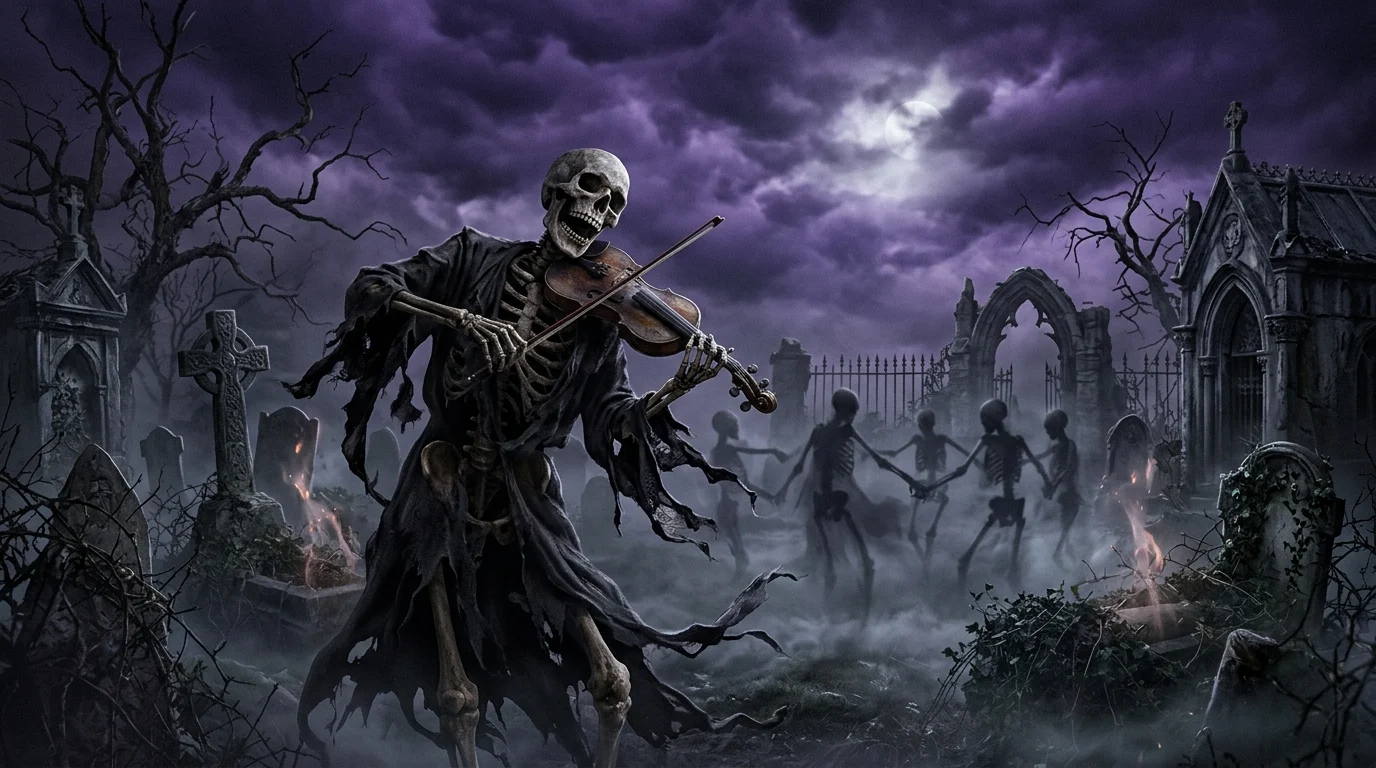
Macabre entered English from French, in the phrase “danse macabre,” meaning the dance of death. In medieval Europe, the dance of death was a powerful artistic theme: a procession in which a figure of Death, often drawn as a skeleton, led people from every walk of life, kings and peasants alike, toward the grave.
The message was deliberately levelling. Wealth, rank, and beauty offered no protection, because death came for everyone in the end. Paintings, poems, and plays on this theme were common in the centuries after the great plagues, when death was a daily presence rather than a distant idea.
The origin of the French word itself is uncertain, but the leading explanation links it to the Maccabees, a Jewish family remembered in the biblical books of Maccabees for their martyrdom and for prayers for the dead. Medieval performances connected with those stories may have given the dance its name. Dictionaries flag this as probable rather than proven, which is honest: the connection is plausible, but the evidence is not complete.
From that narrow beginning, the word broadened. By the modern period, macabre no longer needed an actual dance. Anything grim, death-haunted, and disturbing could earn the label.
Macabre vs Gruesome, Ghoulish, and Morbid
Macabre sits in a family of dark adjectives, and the differences are useful:
- Macabre vs gruesome: Gruesome stresses blood and gore, the physically revolting detail. Macabre stresses the atmosphere of death. Something can be macabre without being gory, like a quiet story about a graveyard at night.
- Macabre vs ghoulish: Ghoulish stresses an unhealthy fascination with death, especially someone who enjoys it. A ghoulish person delights in the macabre.
- Macabre vs morbid: Morbid is broader, covering any unhealthy interest in death, disease, or decay. Macabre is more specific and more literary: it describes the thing itself, not just the interest in it.
- Macabre vs eerie: Eerie means strange and unsettling in a supernatural way. Macabre is grounded in death and the body, not in ghosts or mystery.
In short, if the unsettling quality comes from death and its physical reality, macabre is the right word. If it comes from mystery alone, another word fits better.
Macabre in Literature, Film, and Art
Macabre has always belonged as much to art as to everyday speech. Writers use it to signal a story that treats death not as a passing event but as its central atmosphere. Horror fiction, gothic novels, and dark comedy all trade in the macabre, each in a different key: horror to frighten, gothic writing to unsettle, and dark comedy to make the audience laugh at what should horrify them.
In visual art, the medieval dance of death still echoes. Modern works that arrange skeletons, skulls, or funeral imagery are routinely described as macabre, whether they aim to warn, to mourn, or to shock. The word tells the viewer what register to expect before they look closely.
This artistic use is also why macabre rarely sounds like a neutral description. Calling a museum exhibit macabre is a judgement about its mood, not just a list of its contents.
Macabre in Everyday Sentences
- Police made a macabre discovery in the abandoned house.
- She has a macabre sense of humour and laughs at funerals in films.
- The novel’s macabre opening chapter sets a grim tone for the rest of the story.
- There was something macabre about the row of empty chairs at the cancelled wedding.
- The documentary avoided the macabre details and focused on the survivors.
Notice that in each case the word points at death or injury, even when no violence is described. The empty chairs are macabre because they suggest absence and loss, not because anything graphic happens.
Frequently Asked Questions About Macabre
What does macabre mean in simple terms?
In simple terms, macabre means grim and disturbing because it is connected with death or serious injury. A macabre story, joke, or image dwells on the darker side of death.
What is the danse macabre?
The danse macabre, or dance of death, was a medieval artistic theme in which Death, shown as a skeleton, led people of all ranks in a procession to the grave, reminding viewers that death comes to everyone.
Is macabre the same as scary?
Not quite. Something scary frightens you, but something macabre specifically involves death or injury and a grim, unsettling atmosphere. A ghost story can be scary without being macabre, and a quiet graveyard scene can be macabre without being frightening.
Can macabre be positive?
Rarely, but it can be appreciative. Fans of horror fiction or gothic art may praise something as “delightfully macabre,” meaning they enjoy its dark atmosphere. The word itself stays negative in tone; the praise comes from enjoying that darkness.
How do you pronounce macabre?
British speakers usually say “muh-KAH-bruh,” while American speakers often say “muh-KAHB” or “muh-KAH-bur.” All are widely accepted.
Conclusion
So, what does macabre mean? It is a word with a long shadow, travelling from a medieval dance of skeletons to a modern adjective for anything grimly touched by death. Use it when the disturbing quality comes from death itself, not merely from fear or strangeness, and it will land exactly as intended: a single word that carries centuries of darkness with it.
Related: What Does Fodder Mean? Animal Feed, Figurative Uses & Examples Explained and What Does Antonym Mean? Definition, Types and Examples Explained.


1 thought on “What Does Macabre Mean? Definition, Origin & Examples Explained”