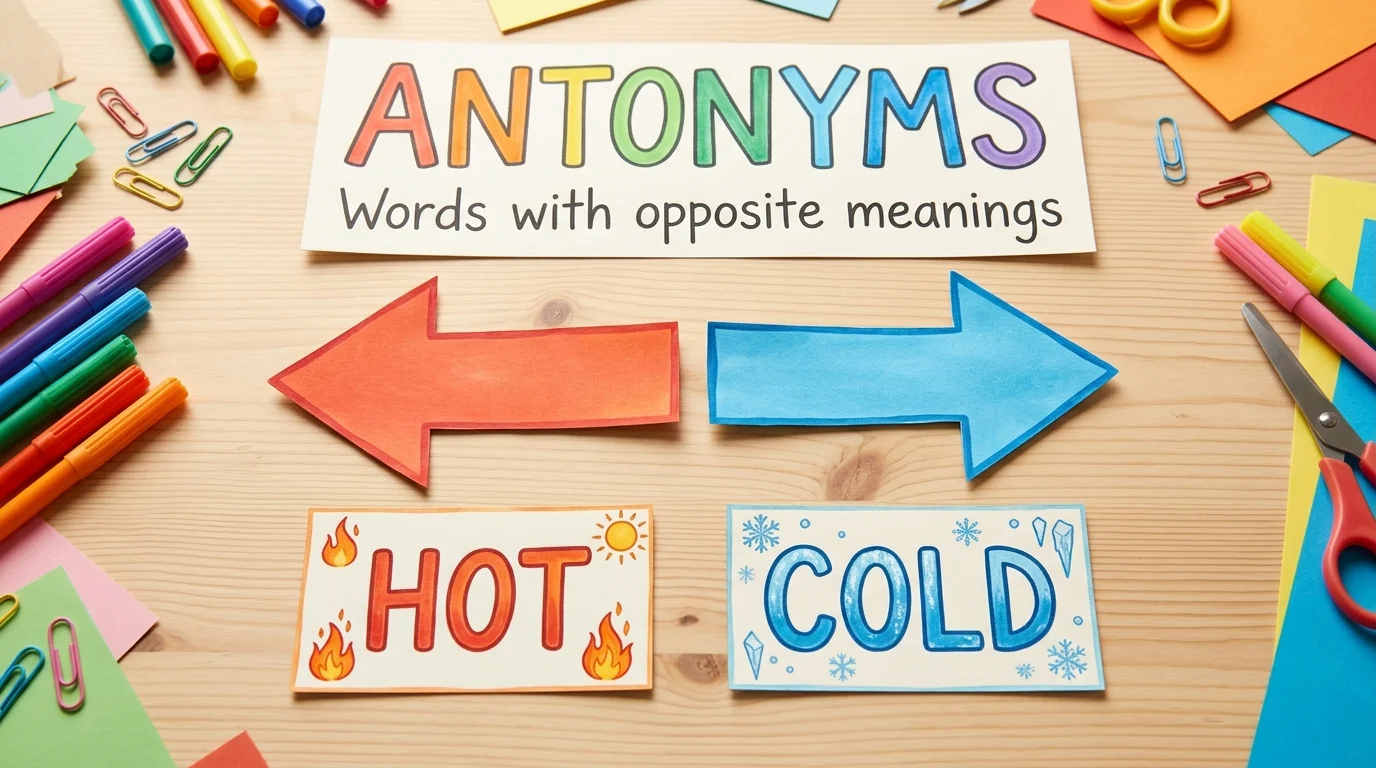
Quick Answer: An antonym is a word that means the opposite of another word. For example, hot is an antonym of cold, fast is an antonym of slow, and happy is an antonym of sad.
Antonyms are one of the first language ideas children learn, and one of the most useful tools in writing at any level. If you want to show contrast, sharpen a description, or avoid repeating yourself, an antonym does the job in a single word.
This guide explains what antonym means in plain language, drawing on standard dictionary and grammar definitions. It covers the main types of antonyms, how they differ from synonyms, and plenty of examples you can use in school, exams, and everyday writing.
What Does Antonym Mean?
An antonym is a word opposite in meaning to another word. The term comes from Greek: anti-, meaning opposite, and -onym, from onoma, meaning name. So an antonym is literally an “opposite name” for something.
Almost any kind of word can have an antonym. Adjectives are the most familiar (hot and cold, big and small), but verbs have them too (arrive and depart, buy and sell), as do nouns (hero and coward, beginning and end) and adverbs (quickly and slowly). Not every word has an antonym, though: concrete nouns like “table” or “pencil” do not have natural opposites, because there is nothing to oppose them against.
One word can also have several antonyms. The antonyms of “good” include bad, poor, terrible, and evil, each with a different strength. Choosing among them is a matter of shade, not just of correctness, which is why a good vocabulary matters in writing.
Types of Antonyms
Language specialists divide antonyms into a few useful types. You do not need to memorise the labels, but knowing the distinctions helps you use opposites precisely.
Gradable Antonyms
Gradable antonyms sit on a scale, with room in between. Hot and cold are gradable, because something can also be warm, cool, or lukewarm. Big and small, rich and poor, and happy and sad work the same way. Saying something is “not hot” does not mean it is cold; it might be somewhere in the middle.
Complementary Antonyms
Complementary antonyms leave no middle ground. Alive and dead, on and off, true and false: one must apply, and the other cannot. Saying something is “not alive” does mean it is dead, which is the test that separates this type from gradable pairs.
Converse Antonyms
Converse antonyms describe the same relationship from opposite sides. Buy and sell, teacher and student, parent and child, above and below: each pair needs the other to make sense. If someone buys something, someone else must sell it. These are sometimes called relational antonyms.
Auto-Antonyms
Some words are their own antonyms. “Cleave” can mean to split apart or to cling together. “Dust” can mean to remove dust or to sprinkle it. “Sanction” can mean to approve or to punish. These words, also called contronyms, are rare and confusing, and context is the only way to tell which meaning is intended.
Antonym vs Synonym
Antonym and synonym are themselves antonyms, which is a neat illustration of the idea. A synonym is a word with the same or a similar meaning to another word: quick is a synonym of fast. An antonym is a word with the opposite meaning: slow is an antonym of fast.
Writers use both together. Synonyms add variety and avoid repetition. Antonyms add contrast and structure, letting a writer set two ideas against each other: “It was not a victory, but a defeat” gains its force from the opposition. Learning words in pairs, a word and its antonym, is also one of the fastest ways to build vocabulary.
Common Antonym Pairs
Here are pairs that come up constantly in English, grouped by type for easy reference:
- Adjectives: hot and cold, big and small, rich and poor, happy and sad, early and late, brave and cowardly.
- Verbs: arrive and depart, buy and sell, win and lose, start and finish, love and hate, remember and forget.
- Nouns: hero and villain, beginning and end, success and failure, friend and enemy, question and answer.
- Adverbs: quickly and slowly, well and badly, always and never, here and there.
Many antonyms are formed simply by adding a prefix: happy becomes unhappy, correct becomes incorrect, possible becomes impossible, and like becomes dislike. That pattern is productive in English, which is why learners can often guess an antonym even for a word they have not seen before.
Frequently Asked Questions
What does antonym mean in simple words?
In simple words, an antonym is an opposite word. Hot is the antonym of cold, and up is the antonym of down.
What is an example of an antonym?
Fast and slow are antonyms. So are happy and sad, big and small, and arrive and depart.
What is the difference between an antonym and a synonym?
A synonym means the same or nearly the same as another word. An antonym means the opposite. Quick is a synonym of fast; slow is an antonym of fast.
Can a word have more than one antonym?
Yes. Good, for example, has bad, poor, terrible, and evil as antonyms, each with a different shade of meaning.
Do all words have antonyms?
No. Words for concrete things, like table or river, usually have no opposite. Antonyms mainly belong to words describing qualities, actions, directions, and relationships.
Conclusion
So, what does antonym mean? It means a word that stands opposite to another word, whether on a scale like hot and cold, as a strict pair like alive and dead, or as two sides of one relationship like buy and sell. Learn antonyms alongside synonyms, practise them in pairs, and your writing will gain contrast, precision, and variety with very little effort.
Related: What Does Gist Mean? Simple Definition, Examples and How to Use It and What Does Rout Mean? Definition, Examples and Rout vs Route Explained.


4 thoughts on “What Does Antonym Mean? Definition, Types and Examples Explained”