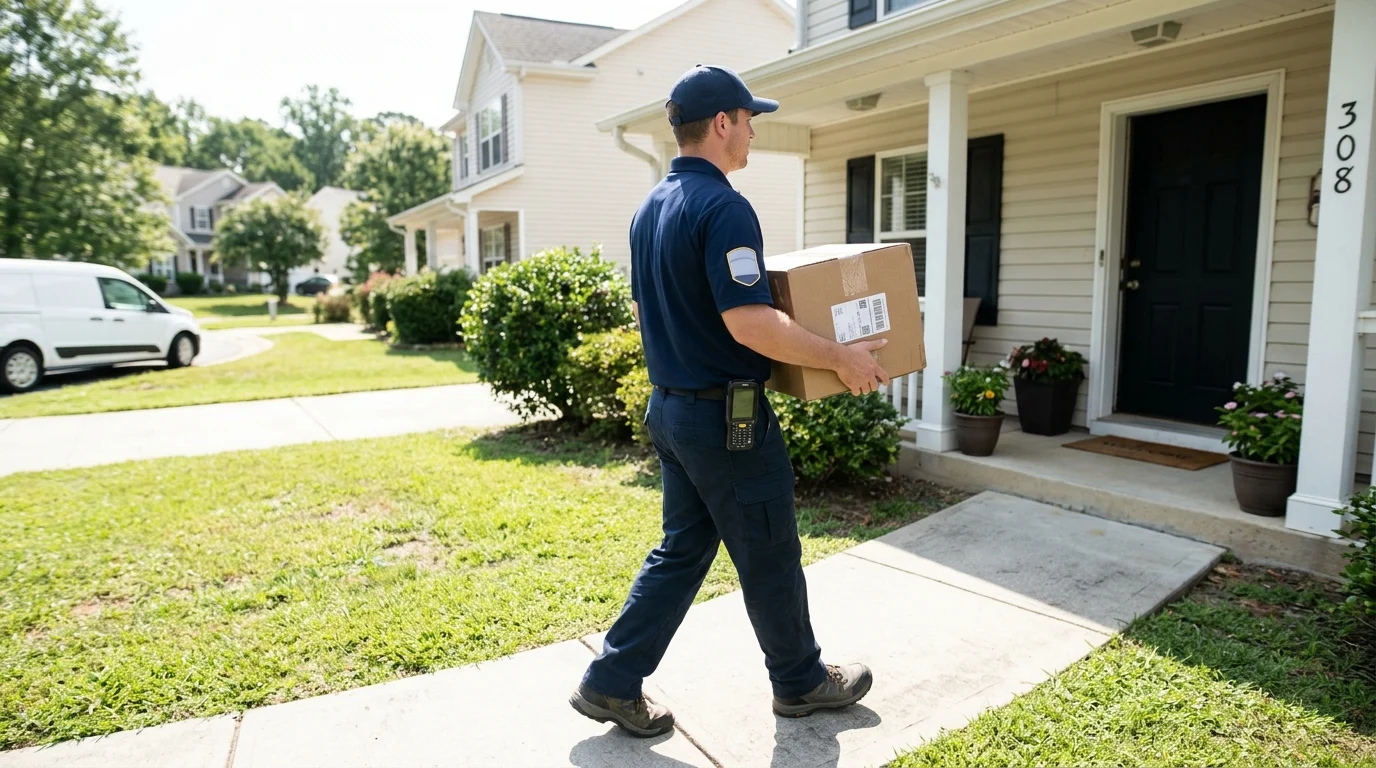
Quick Answer: “Out for delivery” means your package has left the local delivery facility and is loaded on the vehicle that will bring it to you, usually that same day. It is the final step before delivery, but it does not guarantee an exact arrival time.
Few tracking updates cause as much excitement as “out for delivery.” They also cause impatient window-watching. Your parcel has travelled across the country and cleared sorting hubs. It has reached your town and is now officially on its way to your door. Yet hours can pass without a knock. That gap between the status and the doorbell is where most questions arise.
This guide explains what does out for delivery mean in plain terms. It covers where your package actually is and how the final delivery leg works. It also covers when it should arrive and what to do if it does not. UPS, FedEx, USPS, DHL, and Amazon all use the status in broadly the same way.
What Does Out for Delivery Mean, Exactly?
When a carrier marks a package “out for delivery,” the parcel has arrived at the delivery facility nearest to you. Staff have sorted it onto a specific route and loaded it onto the vehicle that will make that route’s stops. In practical terms, your package is no longer travelling between cities. It is in your area, in the hands of the driver or courier assigned to your neighbourhood.
Carriers normally apply the status in the morning, when staff load routes. It usually means delivery is expected that same day. That “usually” matters. The status promises delivery today. It does not promise a particular hour. It also does not promise that nothing can still go wrong.
Note that the driver may have dozens or even hundreds of stops. Your address could be anywhere along the route. A package marked out for delivery at 8am might arrive at 10am or at 7pm. The exact time depends on the route order, traffic, and how many stops come before yours.
How a Package Gets to “Out for Delivery”
The journey to this final status follows a familiar path. First, the seller creates a label and hands the parcel to the carrier. The parcel then travels through regional sorting hubs, sometimes by truck and sometimes by air. Staff scan it at each facility. Eventually it reaches the local facility serving your postcode, usually overnight or in the early morning.
At the local facility, staff sort parcels by delivery route. They load each route’s parcels onto the corresponding vehicle. The moment staff scan your parcel onto that vehicle, the tracking status changes to “out for delivery.” From there, the driver follows the planned route and scans each parcel at delivery.
Some carriers now offer live tracking or an estimated delivery window once the status changes. Amazon, for example, often shows a map and a window of a few hours. Other carriers may only show the status itself. Where a window is shown, treat it as an estimate, not an appointment.
Out for Delivery vs Other Tracking Statuses
Tracking language is confusing because several statuses sound similar. Here is how they differ:
- Label created: The seller printed a label, but the carrier may not have the parcel yet.
- Shipped / accepted: The carrier has received the parcel and it has entered the network.
- In transit: The parcel is moving between facilities, still on its longer journey toward your area.
- Arrived at local facility: The parcel has reached your area but has not yet been loaded for delivery.
- Out for delivery: The parcel is on the final vehicle and should arrive today.
- Delivered: The carrier has recorded a completed delivery, though the parcel may be with a neighbour, in a safe place, or at a collection point.
- Delivery exception / attempted: Something interrupted delivery, such as nobody being available for a signature, an access problem, or a weather delay.
The key distinction is between “in transit” and “out for delivery.” In transit means the journey is still underway. Out for delivery means the journey is essentially over. Only the last mile remains.
When Should Your Package Arrive?
Most residential deliveries happen during the carrier’s normal delivery hours. These commonly run from late morning into the early evening. The exact hours vary by carrier, service level, and location. Drivers usually serve business addresses earlier in the day. Residential routes often run later.
If the tracking page gives an estimated window, that is your best guide. If it does not, a reasonable expectation is delivery before the end of the carrier’s delivery day. Waiting until the following morning before worrying is usually wise. A parcel can appear as delivered slightly after the physical drop. A driver can also run late on a heavy route.
What If “Out for Delivery” Does Not Arrive?
Several things can interrupt the final leg. Bad weather, traffic, vehicle problems, an incorrect or incomplete address, a locked gate, or a signature requirement with nobody home can all push delivery to the next day. In that case the status usually changes to “delivery attempted.” It may return to the local facility, with instructions for redelivery or collection.
If your parcel still shows out for delivery the next morning, check the tracking details for a new scan or message. Confirm the delivery address on your order. Check with neighbours and around your property for a safe-place delivery. If nothing has changed by the end of the next business day, contact the seller first. They hold the shipping contract. You can also contact the carrier with your tracking number.
One common worry deserves a direct answer: a package that says out for delivery but never arrives that day is not necessarily lost. Most such parcels arrive on the next delivery day. This happens after a failed attempt or a route that simply ran out of time.
Tips for a Smooth Final Delivery
- Make the address findable: Include flat or unit numbers, gate codes where the carrier allows them, and any genuinely helpful delivery notes.
- Plan for signatures: If your parcel needs a signature, arrange for someone to be available or use the carrier’s option to redirect it to a collection point.
- Use delivery preferences: Many carriers let you choose a safe place, a neighbour, or a locker in advance, which prevents failed attempts.
- Do not chase the driver: Routes change during the day, and drivers cannot reliably meet customers mid-route. The tracking window is the best guide available.
Frequently Asked Questions
What does out for delivery mean?
It means your package has left the local facility on the vehicle for your area. The carrier expects to deliver it that day.
Does out for delivery mean it will arrive today?
Usually yes, but not guaranteed. Weather, traffic, route delays, or a failed delivery attempt can push it to the next delivery day.
How long after out for delivery will my package arrive?
It depends on your position on the driver’s route. It can be within an hour or near the end of the delivery day. For homes, this is commonly late morning to early evening.
What is the difference between in transit and out for delivery?
In transit means the parcel is still travelling through the carrier’s network toward your area. Out for delivery means it has reached your area and is on the final delivery vehicle.
What should I do if my package says out for delivery but never arrives?
Wait until the next business day. Check for a new scan or a safe-place delivery. Confirm your address. Then contact the seller or carrier with your tracking number.
Conclusion
So, what does out for delivery mean? It means the wait is nearly over. Your parcel is in your area and on its final vehicle. It should reach you today. It is not a precise appointment. The driver may arrive at any point along the route. But it is the most encouraging status a tracking page can show.
When you see those three words, the best move is usually the simplest one. Make sure the address is accessible. Keep an eye out during the day and let the final mile do its work.


