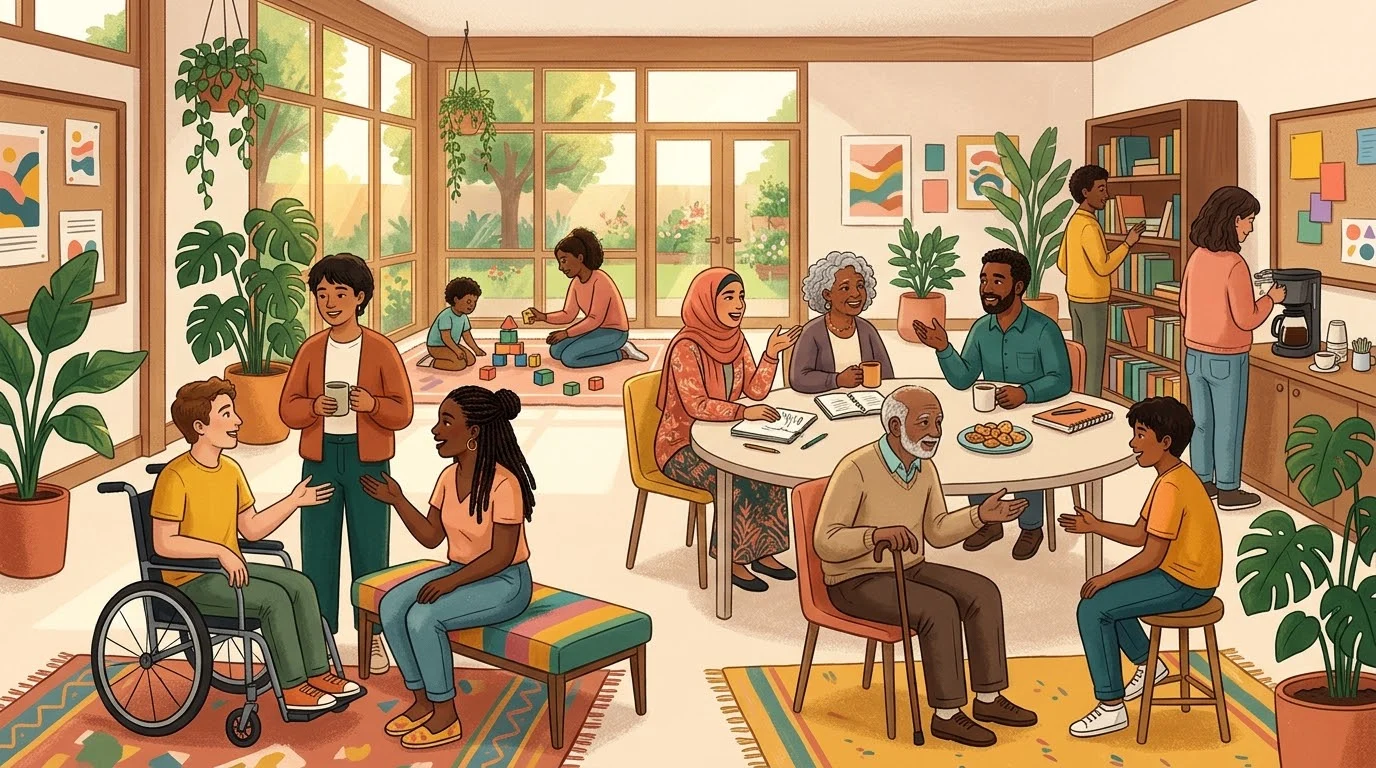
Quick Ans: Inclusive meaning is one of the most searched questions about vocabulary that shapes modern conversation. At its core, inclusive means including everything or everyone, especially those who have historically been excluded. This adjective appears in discussions about education, workplaces, language, and society. Understanding it helps you follow debates about diversity, fairness, and belonging.
The word carries two main senses. The first is broad and simple: including much or everything, like an “inclusive fee” that covers all costs . The second is deeper and more social: not excluding any person on the grounds of race, gender, religion, age, or disability . Both meanings matter, and knowing which one applies helps you use the word correctly.
What Does Inclusive Mean?
Inclusive is an adjective with two primary meanings. The first is comprehensive including everything or a large amount. An inclusive price covers all costs. An inclusive list contains all items .
The second meaning is socially open not excluding any person or group. An inclusive workplace welcomes people of all backgrounds. An inclusive society ensures equal rights and opportunities for everyone .
The word belongs to both casual and formal communication. It fits perfectly in conversations about education, business, and social issues. It also works in everyday speech when describing a welcoming environment. The tone is positive and forward-looking.
Sometimes people use it in the phrase “inclusive of” to mean “including.” A price “inclusive of tax” means the tax is already included . This usage is common in business and travel.
Where Did Inclusive Come From?
The inclusive origin traces back to the Latin word includere, meaning “to enclose” or “to shut in.” The English word entered the language in the 15th century with a literal sense: enclosing or surrounding something .
For centuries, inclusive meant simply “comprehensive” or “including everything.” A book could have an inclusive index. A price could be inclusive of meals. The word was neutral and descriptive .
The social meaning emerged in the 20th century. The first recorded use of inclusive in the sense of “not excluding people” appeared in 1928, in a Rotary International magazine. The magazine described Rotary as wishing to establish “new contacts that are more inclusive,” bringing together lawyers and lumbermen, bankers and bakers .
The word gained its modern social justice association through the civil rights movement. A 1965 issue of The Crisis, the NAACP magazine, described Lyndon Johnson’s Great Society as “an inclusive society from which no American is barred solely because of his race, colour, religion or national origin” .
In the 1970s, the movement for inclusive education focused on including students with disabilities in mainstream schools. The word became a cornerstone of diversity and equity discussions. Today it appears in corporate policies, educational frameworks, and social movements worldwide .
How Inclusive Is Used in Conversations
Inclusive works in several different contexts. Its flexibility is one reason it became so widely used.
In education. “Inclusive education” means all students learn together in the same classrooms, regardless of disability or background. It is not a separate program but a transformation of how schools operate .
In workplaces. An “inclusive workplace” is one where every employee feels valued, respected, and able to contribute. It goes beyond diversity it means people are not just present but actually included in decision-making and culture .
In language. “Inclusive language” avoids terms that exclude or demean specific groups. It focuses on honoring people’s identities rather than simply avoiding offense .
In pricing. “Inclusive of” means including something as part of a total. A hotel rate “inclusive of breakfast” includes the meal in the price .
Inclusive vs Exclusive
The most important distinction for understanding inclusive is its opposite: exclusive.
Inclusive means open, comprehensive, and welcoming. It includes people or things that might otherwise be left out .
Exclusive means restrictive, selective, or closed off. An exclusive club limits membership. An exclusive contract excludes other parties .
The difference matters in social contexts. An inclusive policy welcomes diversity. An exclusive policy creates barriers. An inclusive community values belonging. An exclusive community values status.
The word “inclusive” has largely replaced older terms like “tolerant” in social discussions. Tolerance suggests merely putting up with difference. Inclusion suggests actively valuing and welcoming it .
Inclusive in Education
Education is one of the most common contexts for the word. Inclusive education means that all children, including those with disabilities, learn together in the same schools and classrooms .
This is not just about physical presence. Inclusive education requires transforming curricula, teaching methods, and school cultures so that every student can succeed. It means removing barriers to learning and participation .
UNESCO describes inclusive education as a principle of Education for All, not a separate initiative. It requires addressing the needs of marginalized groups: children with disabilities, working children and those affected by conflict or poverty .
The movement began in the 1970s and gained global momentum through frameworks like the Salamanca Statement. Today it is a core principle in education policy worldwide .
When Not to Use Inclusive
Inclusive does not belong in every conversation. Its positive connotations make it powerful, but also potentially hollow.
Avoid using inclusive as a buzzword without substance. An “inclusive” policy that does not actually change outcomes is performative. The word should describe real transformation, not just good intentions.
Be careful when using inclusive to describe yourself. Calling yourself inclusive is less meaningful than demonstrating inclusive behavior. Actions speak louder than labels.
In some contexts, inclusive can feel like a demand rather than a description. “Be more inclusive” can land as criticism. Use it with sensitivity to the audience and the situation.
Why Inclusive Became So Popular
Inclusive grew alongside the rise of diversity and equity movements. As organizations and societies became more diverse, they needed language to describe the goal of genuine belonging.
The word filled a gap. “Diverse” describes what something is. “Inclusive” describes what something does it actively brings people in. A group can be diverse without being inclusive. Inclusion is the action that makes diversity meaningful .
Corporate culture adopted the term. Diversity and inclusion (D&I) became a standard phrase in human resources. Companies hired inclusion officers and published inclusion reports. The word became a marker of progressive values.
Education embraced it. Inclusive education became a global standard, backed by UNESCO and national policies. The word became shorthand for the belief that every child belongs .
Social movements accelerated its spread. As conversations about race, gender, disability, and sexuality became more visible, inclusive became the word for the goal: a society where no one is left out.
FAQs
What does inclusive mean?
Inclusive means including everything or everyone, especially those who have historically been excluded. It can describe comprehensive prices or welcoming environments.
What is the difference between inclusive and exclusive?
Inclusive means open and comprehensive. Exclusive means restrictive and selective. An inclusive club welcomes all. An exclusive club limits membership.
What is inclusive education?
Inclusive education means all students, including those with disabilities, learn together in mainstream schools with appropriate support and adaptations .
What is inclusive language?
Inclusive language avoids terms that exclude or demean specific groups. It focuses on honoring people’s identities and experiences .
Is inclusive the same as diverse?
No. Diversity describes the presence of differences. Inclusion describes the active effort to make everyone feel valued and able to participate. A group can be diverse without being inclusive .
Conclusion
The inclusive meaning is clear and important. It describes the act of including everything or everyone, especially those who have been excluded. You can use it in conversations about education, workplaces, language, and society. It is a positive word that fits the forward-looking spirit of modern communication. When you see inclusive in a policy or hear it in discussion, you now know exactly what it means. Use it with sincerity, and your conversations about belonging will feel more meaningful.
Discover More:
- Atypical Meaning: What It Really Means & Examples 2026
- Unorthodox Meaning: The Complete Guide to This Word for Breaking Tradition 2026


