Quick Answer: A torta is, most famously, a Mexican sandwich served on a crusty white roll. The same word means different foods elsewhere: a sweet cake in much of Latin America and Europe, a flatbread in parts of Spain, a savoury pie in Italy, and an omelette in the Philippines. The torta meaning always depends on where you are.
For the torta meaning in Mexico, order a torta in Mexico City and you will get a hearty sandwich. Order one in Madrid or Buenos Aires and you may be handed a cake. Ask for one in Manila and you could receive an omelette. None of these is wrong. They are all tortas, shaped by centuries of shared language and very different kitchens.
This guide explains the torta meaning, starting with the Mexican sandwich most English speakers meet first, then touring the other regional meanings so you never order the wrong dish by mistake. You will also learn where the word comes from, what goes inside a classic torta, and how to use the word correctly.
What Is a Mexican Torta? The Torta Meaning in Mexico
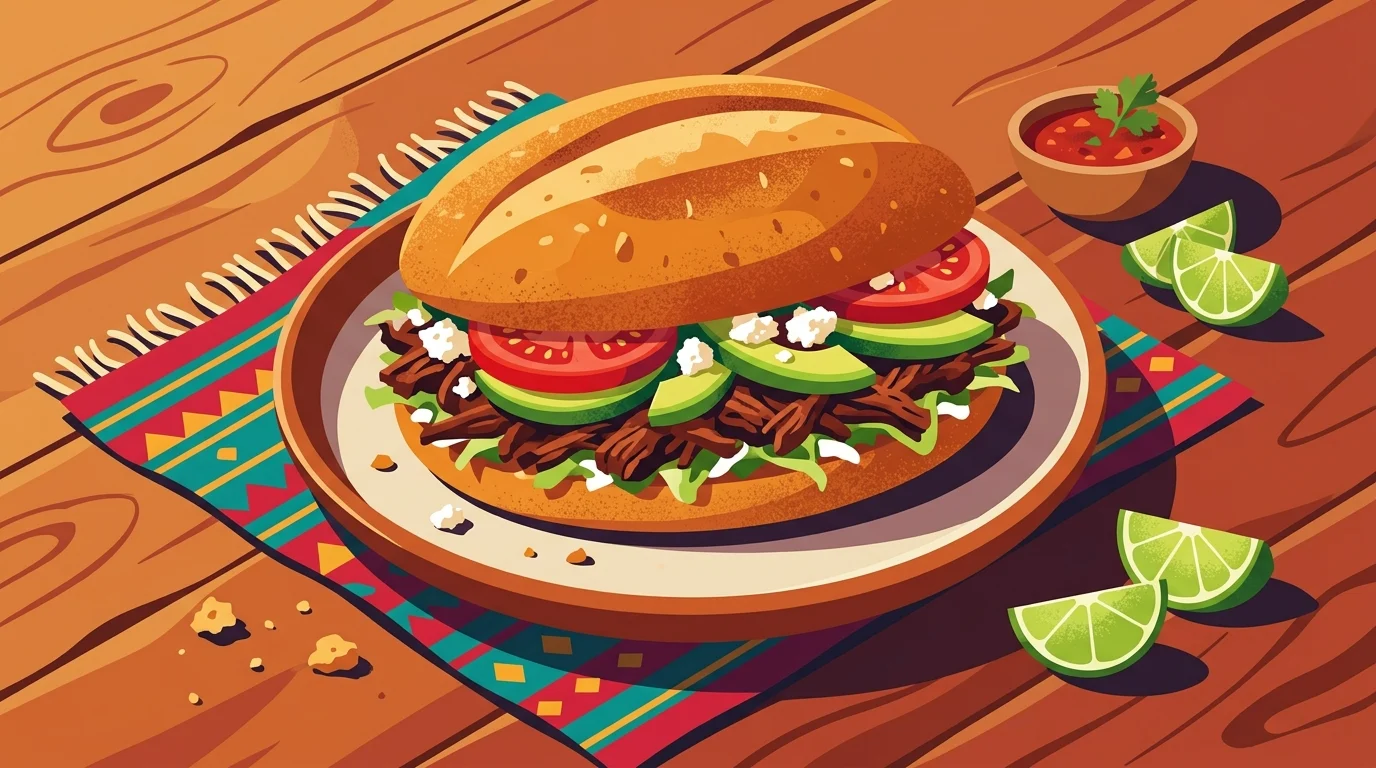
In Mexico, a torta is a sandwich made with a crusty white roll, usually a bolillo or a telera. Vendors slice the roll open, fill it generously, then often press it lightly so it holds together. It is substantial and portable, and people eat it at any time of day, from a quick breakfast to a late-night snack.
What sets a torta apart from an ordinary sandwich is the combination of fillings and the bread itself. The roll has a crisp crust and a soft inside, which stands up to juicy fillings without falling apart. Inside, you will commonly find meat, beans, cheese, avocado, lettuce, tomato, onion, and chillies, along with sauces such as mayonnaise, mustard, or a spicy salsa.
Vendors sell tortas everywhere in Mexico, from street stalls and markets to dedicated shops called torterias. Each vendor has a house style, and regular customers often have a favourite filling they order without thinking. For many Mexicans, a torta is comfort food: familiar, filling, and endlessly customisable.
Where Did the Mexican Torta Come From?
The story of the Mexican torta begins with wheat bread. Before Spanish colonisation, maize tortillas were the everyday staple in Mexico. Wheat bread arrived with Spanish settlers, and over time, French-style breads also influenced Mexican baking, particularly around Puebla, where French forces were present in the 1800s.
From those influences came the bolillo and telera rolls that define the modern torta. Filling a roll with local ingredients created something new: a sandwich that was European in form but Mexican in flavour. The earliest recognisable tortas as we know them date to the 1800s, and one popular story credits a Mexico City vendor named Armando with popularising the filled roll in the 1890s.
Whether or not one person invented it, the torta spread quickly because it solved a practical problem. It was cheap, filling, easy to carry, and cooks could adapt it to whatever ingredients were available. Those qualities have kept it popular ever since.
Popular Types of Mexican Tortas
There are dozens of torta varieties, and the name usually comes from the main filling. Ham fills a torta de jamon. A breaded, fried cutlet, usually chicken or beef, with the usual trimmings, makes a torta de milanesa. Several meats and cheeses load a torta cubana, the everything-in version.
Regional specialities add even more variety. Vendors famously drown the torta ahogada from Guadalajara in a spicy tomato sauce, and diners eat it with a spoon as much as with the hands. The torta de tamal, sometimes called a guajolota, puts a tamale inside a roll for a famously filling breakfast. For the pambazo, a related sandwich, cooks dip its bread in a chilli sauce before grilling, giving it a distinctive red colour and flavour.
If you are trying a torta for the first time, a torta de jamon or torta de milanesa is a safe and delicious starting point. From there, you can explore spicier or more elaborate versions with confidence.
What Goes Inside a Torta?
While fillings vary, most Mexican tortas share a basic structure. First comes a spread, often refried beans, mayonnaise, or both, which adds moisture and helps the fillings stick. Then comes the protein, which might be ham, chicken, pork, chorizo, egg, or a breaded cutlet. Cheese, usually a mild melting cheese, follows, along with avocado for richness.
Fresh vegetables add crunch and balance: shredded lettuce, sliced tomato, onion, and pickled jalapenos are all common. Finally, a sauce or salsa brings heat and acidity. The result is a sandwich that hits many notes at once: salty, creamy, fresh, spicy, and savoury.
Vegetarian tortas are also widely available, often built around beans, cheese, avocado, mushrooms, or egg. The structure stays the same, which shows how flexible the format is. A torta is less a fixed recipe than a way of building a satisfying meal inside a roll.
Torta as Cake: The Torta Meaning in Latin America and Europe
Step outside Mexico and the word changes meaning. In much of Latin America, and in countries like Spain and Italy, torta commonly means a cake. Here, the torta meaning is cake: a birthday torta is a birthday cake, often with layers and a filling of cream or fruit, and a decoration for a celebration. In Mexico, by contrast, people usually call a sweet cake a pastel, which is why visitors can get confused.
The cake meaning is closely related to words you may already know, such as the German Torte and the French tarte. All of them trace back to a shared European baking tradition in which a round, often layered cake or tart was a centrepiece for celebrations. In Brazil and Portugal, torta can also mean a cake or a savoury pie, depending on the filling.
So if a friend from Colombia invites you to eat torta at a party, expect candles and frosting, not a sandwich. The context, a birthday, a wedding, or a bakery display, will usually make the meaning obvious.
Torta as Flatbread in Spain
In parts of Spain, torta can also mean a type of flatbread. These are round, fairly flat breads, sometimes flavoured with olive oil, aniseed, or other local ingredients. They are quite different from both the Mexican sandwich and the Latin American cake, but they share the same root idea: a round, baked item.
Examples survive in central Spain, where regional flatbreads are still made in traditional ways. People may eat them on their own, with cheese, or as part of a rustic meal. For a traveller, the clue is the setting. In a Spanish bakery, a torta on the bread shelf is likely a flatbread, while a torta in the cake case is likely a sweet cake.
Torta as a Savoury Pie in Italy
In Italy, torta most often means a cake, but it can also mean a savoury pie or tart. A famous example is torta pasqualina, a traditional Easter pie from Liguria with greens such as chard or spinach, ricotta cheese, and whole eggs that appear when you slice the pie.
Italian tortas show how one word can stretch across sweet and savoury cooking. The unifying idea is not a single recipe, but a baked dish, often round, made to be sliced and shared. Whether it is sweet or savoury depends on the region and the occasion.
Torta as an Omelette: The Torta Meaning in the Philippines
In the Philippines, the torta meaning takes yet another form: an omelette. Thanks to centuries of Spanish influence, the word entered Filipino cooking, but it attached itself to egg dishes rather than bread or cake. Cooks make the most famous, tortang talong, by grilling eggplant, flattening it, dipping it in beaten egg, and pan-frying it until golden.
Another common version, tortang giniling, uses seasoned ground meat in an omelette. These dishes are staples of home cooking, served with rice and often with a dipping sauce. In the southern Philippines, the word can also refer to a small cake, which shows that even within one country, the meaning can vary by region and language community.
If you see “tortang” on a Filipino menu, the “ng” ending is a clue that you are looking at an omelette-style dish. It is a helpful marker for visitors learning to navigate the menu.
Where Does the Word Torta Come From?
Torta comes from Late Latin torta, short for torta panis, meaning twisted bread. The idea was a round, flat loaf, distinct from taller, yeast-risen breads. Related words include the English tart and the Welsh torth, meaning loaf.
As the word travelled through Spanish, Italian, Portuguese, and other languages, it picked up new meanings in each place it landed. Bakers, cooks, and families adapted it to their own food, and the word adapted with them. That is why a single word can now mean a sandwich, a cake, a flatbread, a pie, and an omelette.
In American English, most people understand torta as a loanword from Spanish, and the Mexican sandwich meaning dominates. If you use the word in the United States, most listeners will picture a sandwich unless the context clearly points elsewhere.
How to Use the Word Torta Correctly
For the torta meaning in any place, follow local usage. In Mexico, or in a Mexican restaurant anywhere, torta means sandwich. A Latin American bakery likely uses it for cake, while a Filipino home likely uses it for omelette. When you are unsure, add a clarifying word: “torta sandwich”, “torta de chocolate” for a chocolate cake, or “tortang talong” for the eggplant omelette.
It also helps to listen for the full dish name. People usually name Mexican tortas by filling, so “torta de milanesa” tells you exactly what to expect. People often name cake tortas by flavour, and Filipino tortas by their main ingredient. The extra word removes the ambiguity that “torta” alone can create.
Frequently Asked Questions
What is a torta in Mexico?
In Mexico, people serve a torta as a sandwich on a crusty white roll, usually a bolillo or telera, filled with meat, beans, cheese, avocado, vegetables, and salsa.
Does torta mean cake or sandwich?
Both, depending on where you are. The torta meaning changes with place: Mexico uses it for a sandwich. Much of Latin America and Europe uses it for cake. The Philippines often uses it for omelette.
What is the difference between a torta and a tortilla?
A torta can be a filled roll or, in other regions, a cake or omelette. In Mexico, a tortilla is a thin flatbread from maize or wheat, used as a wrap or base. The words are related, but they describe different foods.
What is tortang talong?
Tortang talong is a Filipino eggplant omelette. Cooks flatten grilled eggplant, coat it in beaten egg, and pan-fry it until golden, then usually serve it with rice.
What bread is used for a Mexican torta?
People usually make Mexican tortas with bolillo or telera rolls. Both have a crisp crust and a soft centre that holds generous fillings without falling apart.
Conclusion
The torta meaning shows how food words travel. One Latin root, meaning twisted bread, grew into a Mexican sandwich, a Latin American cake, a Spanish flatbread, an Italian pie, and a Filipino omelette. Each version reflects the place that made it its own.
The next time you meet the word, pause and check the setting. Are you in a torteria, a bakery, or a Filipino kitchen? The answer will tell you whether to expect a sandwich, a slice of cake, or a golden omelette, and whichever it is, you will be ready to enjoy it.


3 thoughts on “What Does Torta Mean? Mexican Sandwich & More Explained”