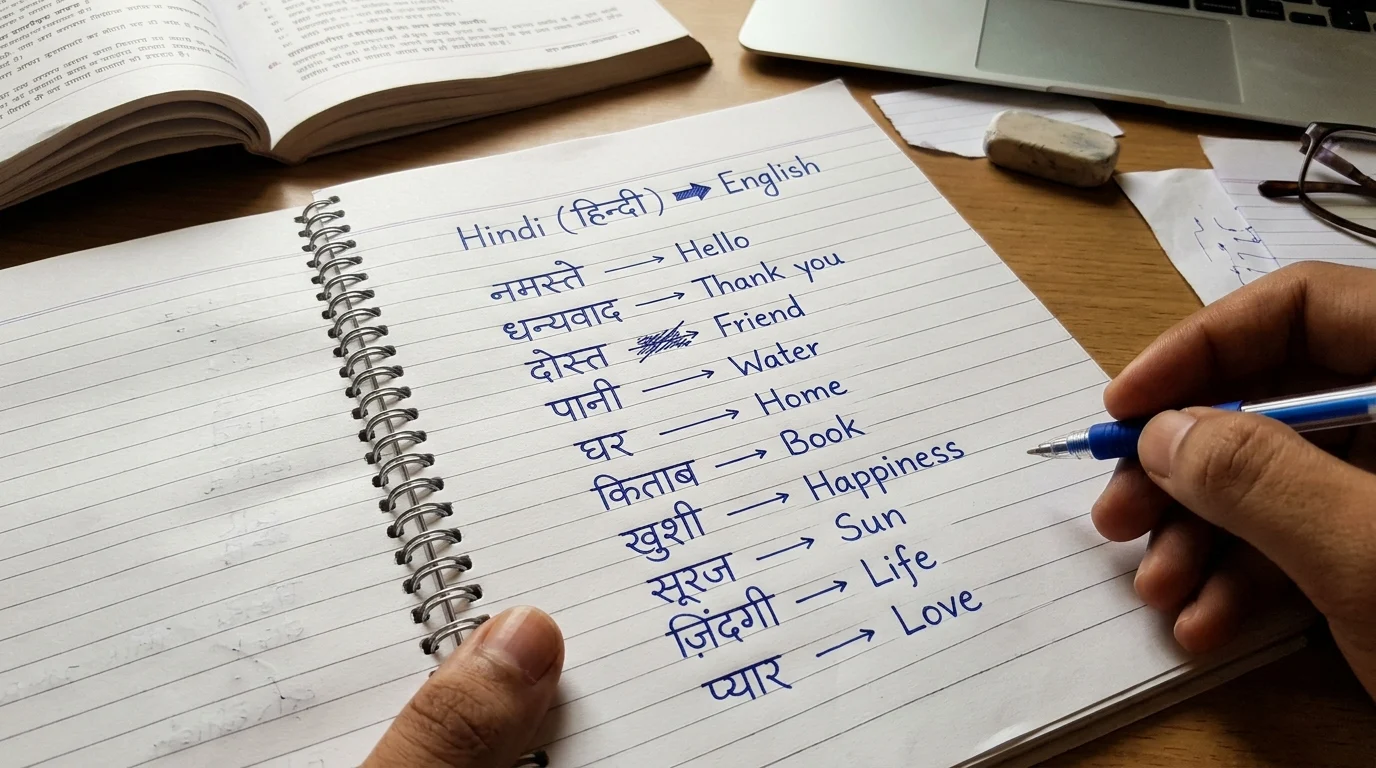
Quick Answer: “Hindi in English” usually means finding the English meaning of a Hindi word, or learning Hindi words with their English translations. For example, namaste means hello, dhanyavaad means thank you, and pyaar means love.
Every day, millions of people search for Hindi words in English: a student doing homework, a traveller preparing for a trip, a parent helping a child, or someone who heard a word in a song or film and wants to know what it means. The search itself is simple, but getting a reliable answer takes a little method.
This guide explains what “Hindi in English” means as a search and a learning goal, gives you a solid starter set of common Hindi words with their English meanings, and shows how to look up any Hindi word accurately, including the ones that have no exact English equivalent.
What Does “Hindi in English” Mean?
The phrase “Hindi in English” is not a single dictionary term. It is how people phrase a translation request. Most of the time it means one of three things: the English meaning of a particular Hindi word, a list of Hindi words translated into English, or help understanding Hindi written in Roman letters, the English alphabet, rather than in Devanagari script.
That last point matters. Hindi is normally written in Devanagari script, but online it is very often written in Roman letters: “namaste” instead of “नमस्ते,” “pyaar” instead of “प्यार.” This Romanised Hindi is easy to type and read for learners, though spellings vary, since there is no single standard for writing Hindi sounds in English letters. The same word may appear as “shukriya” or “shukria,” and both are understood.
Common Hindi Words and Their English Meanings
Here is a starter set of everyday Hindi words, with simple English meanings. These are the words learners meet first, and they cover greetings, politeness, and daily life:
- Namaste (नमस्ते): hello, or a respectful greeting and farewell.
- Dhanyavaad (धन्यवाद): thank you. Shukriya is a common informal alternative.
- Haan (हाँ): yes. Nahin (नहीं) means no.
- Kripya (कृपया): please.
- Maaf kijiye (माफ़ कीजिए): sorry, or excuse me.
- Ghar (घर): home or house.
- Paani (पानी): water.
- Khana (खाना): food, or the act of eating.
- Dost (दोस्त): friend.
- Pyaar (प्यार): love.
- Khushi (ख़ुशी): happiness.
- Sundar (सुंदर): beautiful.
- Kitab (किताब): book.
- Bazaar (बाज़ार): market.
- Din (दिन): day. Raat (रात) means night.
Learning words in small, themed groups like this works better than memorising long lists. Greetings first, then politeness, then home and food, gives you usable language from day one.
Useful Hindi Phrases in English
Single words are a start, but phrases are what you actually use in conversation. These are standard, polite forms:
- Aap kaise hain? How are you? (formal and polite)
- Mera naam … hai. My name is …
- Mujhe samajh nahin aaya. I did not understand.
- Yeh kitne ka hai? How much does this cost?
- Kripya dheere boliye. Please speak slowly.
- Phir milenge. We will meet again, or see you later.
Notice how “aap” is the polite word for “you.” Hindi has levels of politeness, and using “aap” with strangers and elders is the safe default. The familiar “tum” and intimate “tu” are for friends, family, and people you know well.
Hindi Words With No Exact English Meaning
Some Hindi words resist a one-word English translation, and that is part of what makes the language rich. “Jijivisha” describes an intense desire to live life fully. “Moksha” means liberation from the cycle of birth and rebirth, a spiritual concept with no single English equal. “Rimjhim” describes the sound and feeling of light drizzle, carrying a sense of joy at the coming rain that “drizzle” alone does not capture.
When you meet such a word, a good translation gives an explanation, not just a word. If a dictionary offers only one English word for a rich Hindi term, treat it as a starting point and read the fuller explanation before using the word yourself.
How to Find the English Meaning of Any Hindi Word
To look up a Hindi word reliably, follow a few practical steps. First, note whether the word is written in Devanagari or Roman letters, and copy it exactly. Second, check a reputable bilingual dictionary rather than relying on a single search result, since Roman spellings vary and one spelling can hide two different words. Third, look at example sentences: a word’s meaning often depends on context, and examples show you which sense fits your situation. Fourth, if the word is from a song, film, or poem, expect figurative or poetic use, and look for explanations of that specific usage rather than the literal dictionary sense.
It also helps to learn the Devanagari alphabet over time. Even basic recognition lets you check spellings, use Hindi dictionaries directly, and avoid errors caused by inconsistent Romanisation.
Frequently Asked Questions
What does “Hindi in English” mean?
It usually means the English meaning of a Hindi word, or a list of Hindi words translated into English. It can also mean Hindi written in Roman letters using the English alphabet.
What is namaste in English?
Namaste is a respectful greeting meaning hello, and it is also used as a farewell. It carries a sense of respect that plain “hello” does not fully capture.
What is dhanyavaad in English?
Dhanyavaad means thank you. Shukriya is a common, slightly more informal alternative with the same meaning.
Why do Hindi spellings in English letters vary?
Because there is no single standard for writing Hindi sounds in the English alphabet. The same word can appear in several spellings, and all of them may be understood.
Are there Hindi words with no English translation?
Yes. Words like jijivisha, moksha, and rimjhim need explanations rather than single-word translations, because their meanings include cultural and emotional shades that English has no exact word for.
Conclusion
So, what does Hindi in English mean? It means opening a door between two languages: finding the English sense of a Hindi word, learning everyday words and phrases, and discovering the words that need a story rather than a translation. Start with greetings and politeness, learn a few words each day in themed groups, and check meanings in context. With that habit, a search for one word quickly becomes real, usable Hindi.


