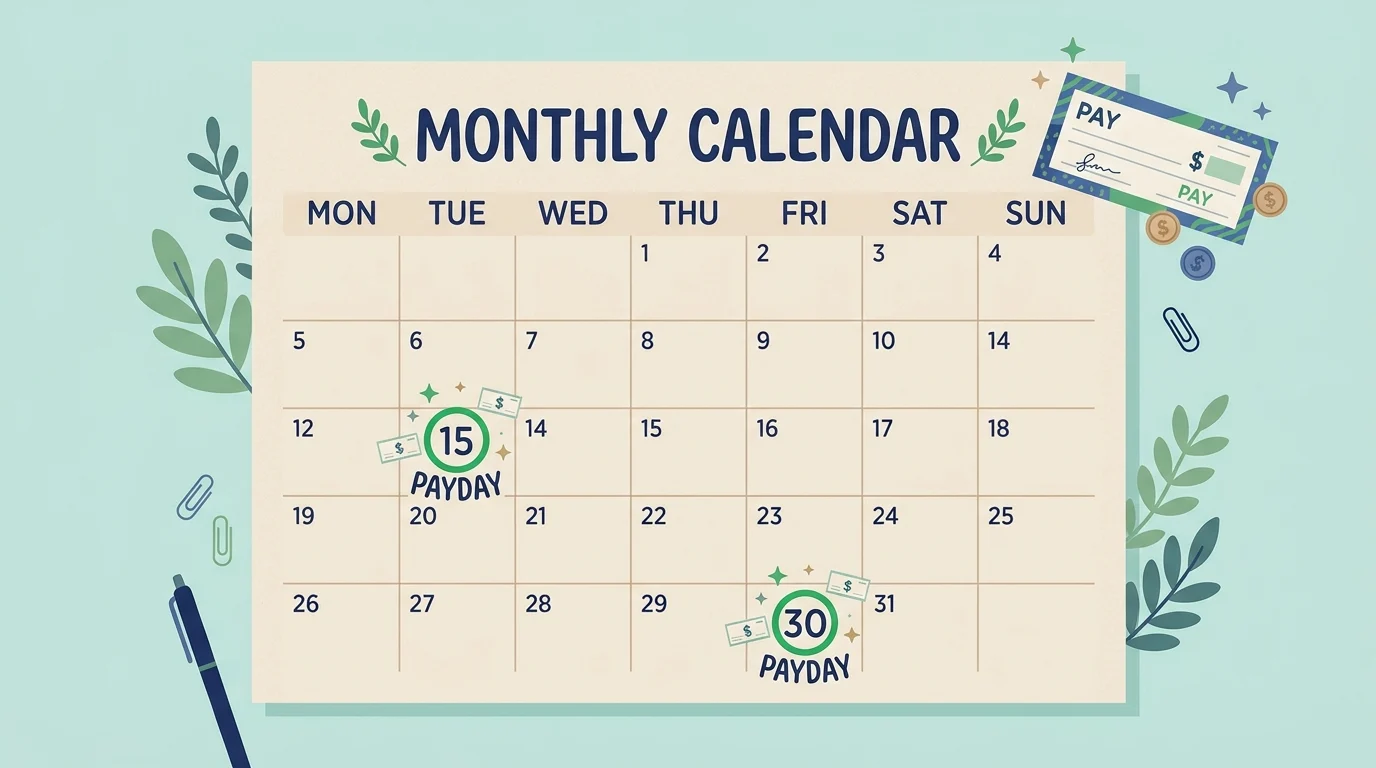
Quick Answer: Semi-monthly means happening twice a month, on fixed calendar dates. In payroll, it means two paychecks every month, usually on the 1st and 15th or the 15th and last day, giving 24 paychecks a year.
If you have ever read a job offer, a pay policy, or a magazine subscription description and paused at the phrase “semi-monthly,” you are not alone. It looks simple, but it is constantly confused with biweekly and bimonthly, and that confusion can change how you budget. This guide explains what does semi monthly mean in plain language, with clear payroll examples, so you can read any schedule with confidence.
Payroll terms are worth getting right, because they decide when money actually lands in your account. The explanation below sticks to the established definitions used by dictionaries and payroll providers, and walks through the arithmetic step by step, so nothing is left to guesswork.
What Does Semi Monthly Mean?
Put simply, what does semi monthly mean is “twice a month.” The prefix “semi” means half, so semi-monthly means half-monthly: something that happens two times within a single calendar month. Oxford Languages defines semi-monthly as an adjective meaning “occurring or published twice a month,” and gives the example of a company using semi-monthly paydays.
The key word is “month.” A semi-monthly schedule follows the calendar month, not weeks. That is why it is different from a schedule based on every two weeks, even though both often produce two payments in a typical month. Semi-monthly always produces exactly two occurrences per month, no more and no less.
Outside payroll, the same definition applies. A semi-monthly magazine comes out twice a month. A meeting on this schedule happens twice a month. Reports on this schedule also arrive twice a month. The context changes, but the meaning stays the same: two times per month.
Semi-Monthly Pay: How It Works
The most common place you will meet this term is payroll. Under a semi-monthly pay schedule, employees receive their wages or salary twice per month, on fixed calendar dates. The two most common pairings are the 1st and 15th of the month, or the 15th and the last day of the month. An employer can choose other dates, but those two patterns dominate because they split the month neatly in half.
Because the dates are fixed, they stay the same every month, regardless of whether the month has 28, 30, or 31 days. That consistency is the main appeal. You always know there will be two paydays in each calendar month, which makes it easier to line up rent, mortgage payments, and other monthly bills.
There is one important wrinkle: fixed dates do not always fall on weekdays. When a scheduled payday lands on a Saturday, Sunday, or bank holiday, most payroll departments move the payment to the preceding business day. If the 15th falls on a Sunday, for example, you would typically receive your deposit on Friday the 13th, so your money is not stuck waiting over a weekend.
For salaried employees, uneven period lengths do not change the amount: employers simply divide the annual salary into 24 equal payments.
How Many Paychecks Do You Get on a Semi-Monthly Schedule?
The arithmetic is straightforward. Two paychecks per month, multiplied by 12 months, equals 24 paychecks per year. That number never changes on a semi-monthly schedule, which is part of why employers and employees like its predictability.
For a salaried employee, the gross amount per paycheck is easy to work out: divide the annual salary by 24. Someone earning $60,000 a year, for example, would receive $2,500 before deductions in each semi-monthly paycheck. Someone earning $48,000 a year would receive $2,000 per paycheck. Payroll teams then calculate taxes and other deductions per pay period, but total annual income sets the annual tax liability, not how often you receive pay.
For hourly employees, the picture is a little more complex. Each semi-monthly period contains a different number of workdays, so hours can vary from one paycheck to the next. Employers still have to track overtime based on the actual workweek, usually a fixed seven-day period, regardless of how the calendar lines up. That extra tracking is one reason payroll teams need to be careful with semi-monthly schedules for hourly staff.
Semi-Monthly vs Biweekly: The Difference That Matters
This is where most confusion happens, so it deserves a clear comparison. Semi-monthly and biweekly sound almost identical, and in many months they even look identical, with two paychecks arriving. But they run on completely different clocks.
Semi-monthly means twice per month on fixed calendar dates, giving 24 paychecks a year. Biweekly means every two weeks on the same day of the week, giving 26 paychecks a year, because 52 weeks divided by two is 26. In some years, a biweekly schedule can even produce 27 pay periods, depending on the exact payroll calendar.
The practical difference shows up in two ways. First, a biweekly schedule drifts across the calendar. Most months you get two checks, but about twice a year you get three, because a 14-day cycle does not fit neatly into calendar months. Semi-monthly never drifts: every month has exactly two paydays. Second, biweekly paydays always fall on the same weekday, while semi-monthly paydays fall on different weekdays each month, since the dates are fixed but the calendar shifts.
For budgeting, semi-monthly is often easier because monthly bills and monthly pay line up neatly. For employees who like the occasional extra paycheck, biweekly has its own appeal, since those three-paycheck months feel like a bonus. Neither schedule is universally better; the right fit depends on the employer, the workforce, and how payroll is managed.
Semi-Monthly vs Bimonthly: Another Common Mix-Up
If biweekly is confusing, bimonthly is doubly so, because the prefix “bi” can mean both “twice in” and “every two.” In payroll usage, people often use bimonthly to mean the same thing as semi-monthly: two paydays per month, 24 per year. Strictly speaking, however, bimonthly can also mean every two months, which would be only six occurrences a year.
That ambiguity is exactly why careful employers and writers prefer “semi-monthly” when they mean twice a month. It leaves no room for doubt. If you see “bimonthly” in a job offer or policy document and the meaning is not clear from context, it is always worth asking: do you mean twice a month, or every two months? A single question can prevent a real budgeting surprise.
A quick summary helps keep the three terms straight:
- Semi-monthly: Twice a month, on fixed dates. 24 times a year.
- Biweekly: Every two weeks, on the same weekday. 26 times a year.
- Bimonthly: Ambiguous. Usually means twice a month in payroll, but can also mean every two months. Always confirm.
Semi-Monthly in Everyday Examples
The term appears well beyond payroll. Seeing it in different contexts makes the meaning stick:
- The company pays its employees on a semi-monthly basis, on the 1st and 15th.
- Our team holds semi-monthly check-ins, once at the start of the month and once in the middle.
- The newsletter comes out semi-monthly, so subscribers receive two issues each month.
- Semi-monthly reports are due on the first and third Wednesdays of every month.
- She visits the farmers market semi-monthly, roughly every two weeks within the month.
Notice that in the last example, “roughly every two weeks” still means twice within the month. The dates do not have to be exactly 14 days apart. What matters is the count: two occurrences per calendar month.
Pros and Cons of a Semi-Monthly Pay Schedule
Advantages
- Predictability: Two paychecks every month, every month, with no surprise three-paycheck months or gaps.
- Bill alignment: Monthly expenses like rent and subscriptions line up naturally with two paydays per month.
- Simple salary maths: Annual salary divided by 24 gives a clean, consistent gross amount per paycheck.
- Benefit deductions: Monthly costs like insurance premiums and retirement contributions fit neatly into a twice-a-month cycle.
Disadvantages
- Uneven pay periods: Periods range from about 13 to 16 days, which complicates hourly pay and overtime tracking.
- Shifting weekdays: Paydays fall on different days of the week each month, and can land on weekends or holidays.
- No bonus months: Unlike biweekly pay, there is never a month with an extra third paycheck.
- Payroll complexity: Employers must be careful to apply weekly overtime rules even though pay periods do not match weeks.
Semi-monthly schedules are especially common for salaried roles and in sectors like finance, education, healthcare administration, and corporate settings, where pay is predictable and monthly benefits are standard. Hourly teams can use the schedule too, but the payroll work behind it takes more care.
Frequently Asked Questions About Semi-Monthly
What does semi monthly mean in pay?
In pay, what does semi monthly mean is that employers pay you twice a month on fixed dates, such as the 1st and 15th, giving 24 paychecks a year. Divide the annual salary by 24 to work out the amount for salaried staff.
Is semi-monthly the same as biweekly?
No. Semi-monthly means twice a month on fixed calendar dates, 24 paychecks a year. Biweekly means every two weeks on the same weekday, 26 paychecks a year, with occasional three-paycheck months.
Is semi-monthly the same as bimonthly?
In payroll, people often use the two to mean the same thing, but bimonthly is ambiguous because it can also mean every two months. Semi-monthly is the clearer term for twice a month.
How many hours are in a semi-monthly pay period?
For a full-time salaried employee, a semi-monthly paycheck often reflects around 86.67 hours, which is the standard figure payroll systems use when spreading a full-time schedule across 24 periods. Actual hours for hourly staff vary by period.
What happens if a semi-monthly payday falls on a weekend?
Most employers move the payment to the preceding business day, so you receive pay before the weekend rather than after it. Your employer should tell you in advance whenever a payday shifts.
Does semi-monthly pay affect my taxes?
No. Your total annual income sets your tax liability, not how often you receive pay. Payroll software adjusts the withholding per paycheck to account for the number of pay periods.
Conclusion
So, what does semi monthly mean? It means twice a month, on fixed calendar dates. In payroll, that translates to two paychecks every month and 24 paychecks a year, most often on the 1st and 15th or the 15th and last day. It is not the same as biweekly, which runs every two weeks for 26 paychecks a year, and it is clearer than bimonthly, which can mean two different things. Once you know that one distinction, semi-monthly schedules become easy to read, easy to budget around, and easy to spot in any job offer or pay policy.