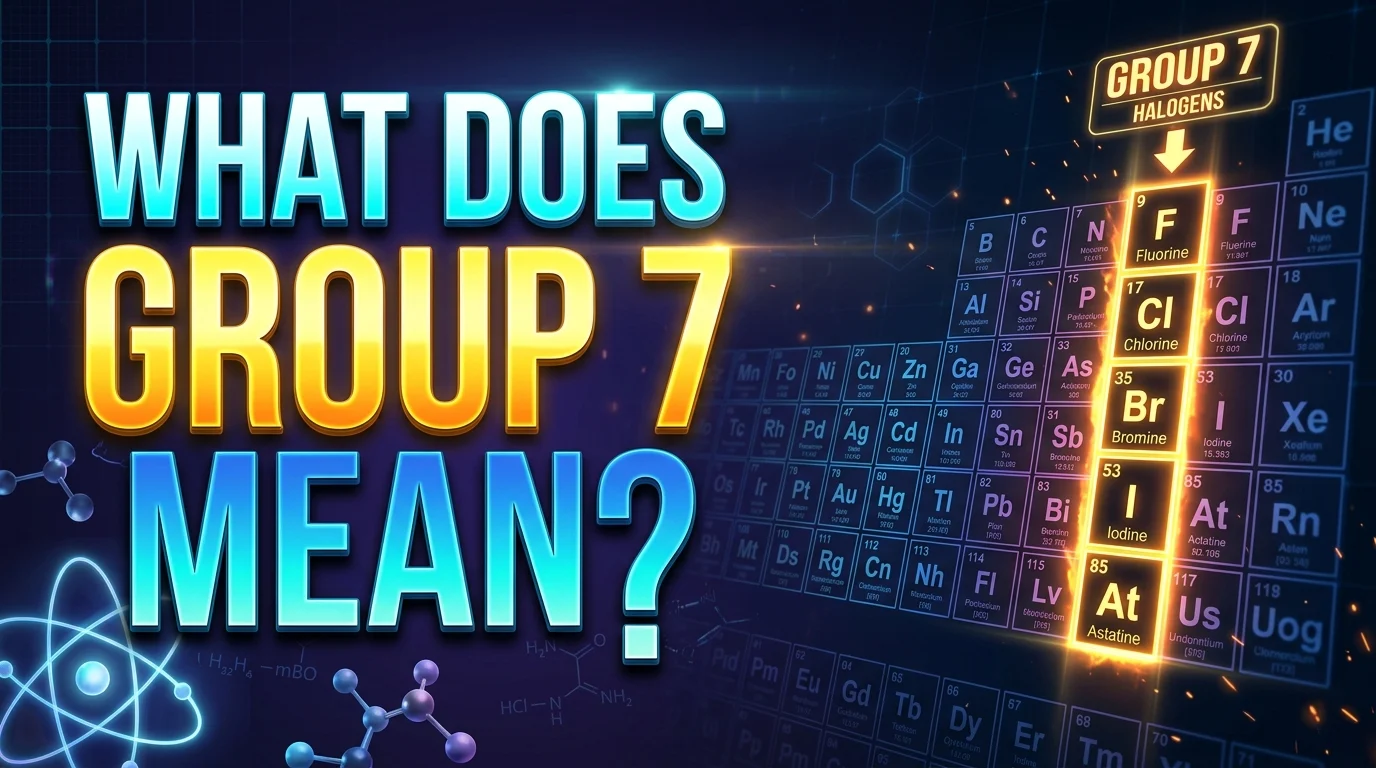
Quick Ans: “What does group 7 mean” is a question that seems simple until you realize the answer depends entirely on who is asking and in what context. The term “Group 7” appears in chemistry classrooms, political summits, football stadiums, and even art history textbooks. Each usage carries its own distinct meaning, and confusing them can lead to some truly puzzling conversations.
Understanding what “Group 7” means requires recognizing that the phrase functions as a label, not a fixed definition. Its meaning shifts based on whether you’re discussing the periodic table, international economics, sports tournaments, or Canadian landscape painting. Knowing how to identify the correct context and what each usage signals can sharpen your comprehension and prevent misunderstandings.
What Does “Group 7” Actually Mean?
At its most basic level, “Group 7” refers to the seventh grouping in a categorized system. The specific meaning depends on the system being referenced. The phrase functions as a descriptive label, and it belongs to contexts where collections of items, nations, or elements are organized numerically.
Unlike some numbered labels that carry consistent associations, “Group 7” is remarkably context dependent. A chemist discussing Group 7 elements is speaking about completely different subject matter than a football analyst discussing Group 7 fixtures. The word adapts entirely to its environment.
The term itself carries no slang or informal tone unless used in a casual context. It is universally understood as a categorization label, though the public’s familiarity with each specific usage varies dramatically.
Where Did the Term “Group 7” Come From?
The origin of “Group 7” as a label traces back to the fundamental human practice of organizing information into numbered categories. The specific applications developed independently across different fields.
In chemistry, the concept of numbered groups emerged from the periodic table’s development in the 19th century. Dmitri Mendeleev’s periodic table organized elements by atomic weight and chemical properties, creating vertical columns that eventually became standardized as groups. Group 7, containing fluorine, chlorine, bromine, iodine, and astatine, earned the name “halogens” from Greek roots meaning “salt formers” because of their reactivity with metals .
In international politics, the “Group of Seven” label emerged from informal meetings of economic powers beginning in the 1970s. The first meeting in 1975 brought together leaders of major industrialized nations to address economic crises, and the group evolved into the G7 format when Canada joined in 1976 .
In sports, “Group 7” typically refers to a tournament bracket designation. FIFA World Cup draws, UEFA Champions League group stages, and continental competitions like the Asian Cup all use lettered or numbered groups to organize teams for the initial phase of competition.
The phrase itself is not a single word with an etymological journey but rather a functional label that different systems adopted independently for organizational purposes.
How “Group 7” Is Used Across Different Fields
The versatility of “Group 7” is remarkable. Its meaning shifts so dramatically between contexts that the same two word phrase can describe completely unrelated concepts.
In Chemistry: The Halogens
The most technically precise usage of “Group 7” appears in chemistry. In the periodic table, Group 7 (also called Group 17 in the IUPAC numbering system) contains the halogens: fluorine, chlorine, bromine, iodine, and astatine . These elements share a crucial characteristic: seven electrons in their outermost shell, which makes them highly reactive as they seek to gain one additional electron to achieve stability .
The halogens are all reactive non metals. They react with metals to form metal halides and with hydrogen to form acidic hydrogen halides. A key trend is that reactivity decreases as you move down the group, because the outer electrons become farther from the nucleus and are less readily attracted .
Some periodic tables use a different numbering system where Group 7 refers to the manganese group manganese, technetium, rhenium, and bohrium which are transition metals . This numbering discrepancy is why modern IUPAC standards generally use Group 17 for the halogens to avoid confusion.
In Politics and Economics: The Group of Seven (G7)
In international relations, “Group 7” almost always refers to the G7, an informal forum of seven leading industrialized democracies. The current members are Canada, France, Germany, Italy, Japan, the United Kingdom, and the United States, with the European Union participating as a non enumerated member .
The G7 is not a formal international organization. It has no secretariat, no permanent staff, and no budget. It operates through annual summits where heads of state and government discuss global economic issues, security, climate change, and development . The presidency rotates annually among members, and the presiding country sets the agenda and hosts the summit.
The group’s decisions are not legally binding, but they carry significant political weight given the economic power of its members. Over time, the G7 agenda has expanded from its original focus on financial stability to include global health, gender equality, counterterrorism, and climate change .
Russia joined in 1998, creating the G8, but its membership was suspended in 2014 following the annexation of Crimea, returning the group to the G7 format .
In Sports: Tournament Groupings
In sports, “Group 7” simply identifies a bracket in a tournament’s group stage. The composition and significance vary by competition.
For the 2026 FIFA World Cup, Group 7 (also labeled Group G) includes Belgium, Iran, Egypt, and New Zealand . In the 2027 AFC Asian Cup, Saudi Arabia was placed in Group 7 with Jordan, Tajikistan, and a playoff winner . Note that different competitions may use different numbering systems; some use letters (Group G) while others use numbers (Group 7).
In these contexts, “Group 7” carries no inherent meaning beyond its organizational function. Its significance comes entirely from which teams are drawn into it and how they perform.
In Art History: The Canadian Group of Seven
A lesser known but historically significant usage refers to the Group of Seven, a collective of Canadian landscape painters active in the 1920s and 1930s. This group is credited with developing a distinct Canadian style of painting, focusing on the rugged landscapes of the Canadian Shield .
This usage is almost always written as “Group of Seven” rather than “Group 7,” and it represents one of the phrase’s two primary meanings according to Canadian terminology guides .
Compared to Similar Terms
Understanding what “Group 7” is not can be as valuable as understanding what it is. Several related terms overlap in confusing ways.
“Group of Seven” spelled out typically refers to either the political G7 or the Canadian painters, depending on context. The numerical abbreviation “G7” almost exclusively refers to the political alliance. “Group 7” in technical contexts like chemistry specifies a periodic table column.
“Group 17” is the modern IUPAC designation for the halogens, preferred over “Group 7” to avoid confusion with transition metal numbering systems .
“G8” was the designation when Russia was a member of the political group, now defunct in that format .
In everyday conversation, the clearest equivalents depend on context: “the halogens” for chemistry, “the G7” for politics, “Group G” for certain sports tournaments.
When Not to Use “Group 7”
Precision matters when using this term, and ambiguity can cause confusion.
In chemistry, prefer “Group 17” when referring to halogens unless you are certain your audience uses the older numbering system. The ambiguity between halogen Group 7 and transition metal Group 7 is a genuine source of confusion in educational settings.
In political discussions, “G7” is the standard abbreviation. Spelling it out as “Group 7” may cause momentary confusion with sports or other contexts.
In sports, always verify which numbering system the specific tournament uses. Some competitions use letters (A H), while others use numbers (1 8). FIFA World Cup 2026 used both “Group 7” and “Group G” interchangeably in official communications .
Be aware that “Group of Seven” without the numeral is the standard form for the Canadian painters. Using “Group 7” for this artistic collective would be unusual.
Why the Term Remains Relevant
“Group 7” persists because numbered categorization remains fundamental to how humans organize information. Chemistry classrooms still teach periodic table groups. International summits still convene under the G7 banner. Sports tournaments still use group stages to manage complex competitions.
The term’s utility lies in its simplicity. It identifies a specific subset within a larger system without requiring lengthy explanation, provided the context is clear. Whether you’re a student memorizing halogen properties, a journalist covering a G7 summit, or a fan tracking World Cup fixtures, “Group 7” serves as a convenient shorthand.
FAQs
What does “Group 7” mean in chemistry?
In chemistry, Group 7 typically refers to the halogens fluorine, chlorine, bromine, iodine, and astatine which have seven electrons in their outer shell. Some older periodic tables use Group 7 for the manganese group of transition metals .
What is the difference between G7 and Group of Seven?
They refer to the same political entity. G7 is the abbreviated form, while Group of Seven is the spelled out version. Both refer to the informal forum of major industrialized democracies .
Is “Group 7” the same as “Group of Seven” in art?
Not typically. The Canadian painters are almost always called the “Group of Seven” spelled out. “Group 7” would be an unusual way to reference them .
What countries are in Group 7 for the 2026 World Cup?
Group 7 (also Group G) includes Belgium, Iran, Egypt, and New Zealand .
Conclusion
The question “what does group 7 mean” has no single answer. It describes halogens in chemistry, a powerful economic alliance in politics, a tournament bracket in sports, and a historic art collective in Canadian culture. The term’s meaning is entirely determined by context and misunderstanding that context can lead to genuinely confusing conversations. When you encounter “Group 7” in the wild, your first task is identifying the system being referenced. Once you know whether you’re in a chemistry lab, a diplomatic briefing, a football stadium, or an art gallery, the meaning becomes clear. Use it with awareness of its multiple lives, and your communication will be more precise and less prone to crossed wires.
Discover More:
- Pushing P Meaning: What This Viral Slang Phrase Stands For 2026
- What Does GTS Mean? Texting & Slang Explained 2026











4 thoughts on “What Does Group 7 Mean? Simple Explanation 2026”