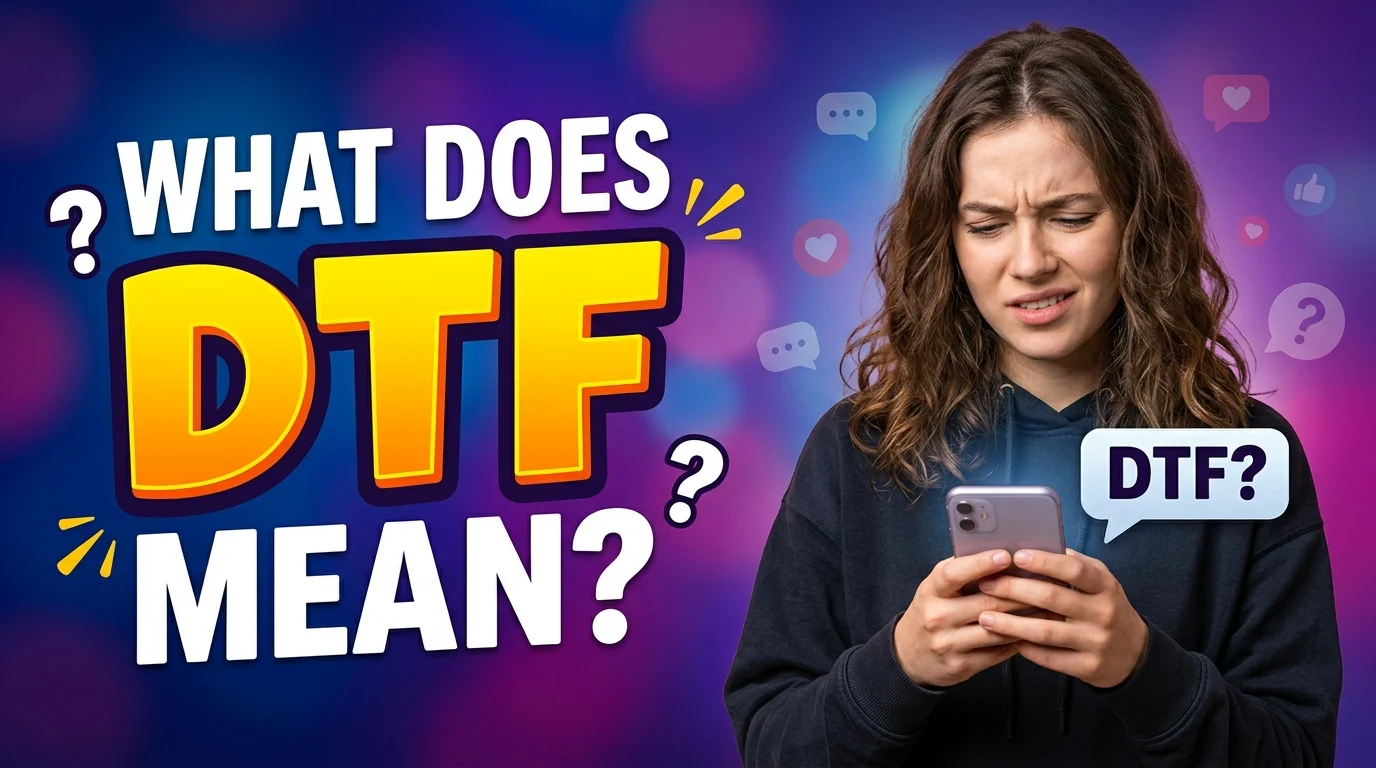
Quick Ans: “What does DTF mean” is one of those questions people often search for privately, usually after encountering the acronym in a dating profile, a text message, or a social media post. In its simplest form, DTF stands for “Down To F***,” a vulgar slang phrase indicating that someone is willing to engage in a casual sexual relationship . It is a word that signals immediate availability, explicit intent, and a deliberate rejection of romantic ambiguity.
Understanding this acronym helps you navigate not just online dating, but the broader culture of hookup apps and casual encounters that has become a defining feature of modern digital romance. DTF is not a centuries old word with literary roots. It is a product of internet culture and texting shorthand, emerging in the early 2000s and gaining mainstream traction through pop culture and dating platforms . Knowing how to interpret it correctly and what it signals in different contexts can protect you from misunderstanding, awkwardness, or worse.
What Does This Acronym Actually Mean?
DTF is an initialism that stands for “Down To F***” . The phrase functions as a blunt declaration of sexual availability. It can describe a person’s current willingness to have sex, or it can be used as a question (“Are you DTF?”) to gauge another person’s interest in a casual encounter.
The term belongs to informal, vulgar slang. It is not appropriate for professional settings, polite conversation, or any context where explicit sexual language would be unwelcome. Its tone is direct, unromantic, and deliberately unsubtle.
Unlike some slang terms that carry playful or ambiguous meanings, DTF is remarkably consistent. It does not suggest a desire for a relationship, a date, or even a conversation. It signals a specific, short term intention: sexual activity without commitment . While some people use it jokingly or ironically, the underlying meaning remains explicit.
Where Did This Acronym Come From?
The origin of DTF traces back to the early 2000s, a period when internet slang and texting abbreviations were rapidly reshaping casual communication. Green’s Dictionary of Slang identifies the term as emerging in the 2000s, and Urban Dictionary’s first entry for DTF dates to 2002 . It’s likely that the acronym’s rise is tied to the same forces that produced other texting shortcuts: the desire for speed, brevity, and a certain edgy efficiency.
The full phrase “down to fuck” appeared in popular music slightly before the acronym went viral. Big Pun’s 1998 song “Still Not A Player” included the line “Who’s down to fuck tonight?” and amazing Town’s 2001 track “Revolving Door” featured the lyric “But don’t waste my time / Unless you’re down to fuck” . These early uses helped seed the phrase in cultural consciousness.
The acronym itself, however, became mainstream in the early 2010s, largely thanks to MTV’s Jersey Shore, where cast members used it frequently in reference to hookups and casual encounters . From there, it spread rapidly through dating apps, social media, and text messaging, becoming a standard piece of shorthand for anyone navigating the world of casual sex.
How It Is Used in Everyday Language
DTF appears in a narrow but highly recognizable range of situations. Its usage is almost always tied to dating, hookup culture, or sexual negotiation.
The most common usage is as a direct question or statement in texting and dating apps. Someone might send a message that simply reads “DTF?” to ask if the other person is interested in sex . In dating profiles, listing “DTF” serves as a signal that the person is not looking for anything serious and wants to make their intentions clear from the outset .
Another usage is as a descriptor for someone else. A person might say “He’s definitely DTF” or “She seems DTF” to indicate that they believe someone is open to a casual encounter. This usage is often part of gossip or strategizing among friends.
The term also appears in pop culture references, memes, and jokes. Because the acronym is so blunt, it lends itself to parody and wordplay. The most famous example is OkCupid’s 2018 advertising campaign, which reimagined DTF as “Down to Fall Head Over Heels,” “Down to Fight About the President,” “Down to Farmer’s Market,” and dozens of other playful variations . The campaign’s goal was to subvert the acronym’s crude origins and reclaim it as a statement of personal identity and values .
Pronunciation is straightforward: DTF is spoken as individual letters, “D T F.” It is not pronounced as a word.
Compared to Similar Terms
Several other terms overlap with DTF in meaning, but each carries distinct connotations.
“Hook up” is a broader, less explicit term. It can mean anything from kissing to sex, and it carries less directness than DTF. While “hook up” can be ambiguous, DTF is not.
“Netflix and chill” emerged as a euphemism for a casual sexual encounter, often with the pretense of watching a movie. It is softer and more playful than DTF, which makes no attempt to disguise its intent.
“Fuck buddy” or “friends with benefits” describe ongoing casual sexual relationships. DTF, by contrast, typically refers to a single encounter or an immediate willingness, not an established arrangement.
“Down to” in other contexts simply means willing or enthusiastic. “I’m down to get pizza” is harmless. DTF is the specific, sexualized version of this construction, and it is understood as such.
The Term in Popular Culture
DTF’s cultural footprint extends beyond dating apps and text messages. It has appeared in songs, films, and advertising, often as a shorthand for the no strings attached ethos of modern hookup culture.
The acronym’s most prominent moment in mainstream advertising came in 2018, when OkCupid launched its controversial “DTF” campaign . The ads, which appeared on public transit and billboards in major cities, redefined the F in DTF with dozens of different words: “Down to Fall Head Over Heels,” “Down to Filter Out the Far Right,” “Down to Focus on My Chakras,” and even “Down to Farmer’s Market” . The campaign was designed to take a phrase “typically used as a label on young women, one that they have no say or no voice in,” according to OkCupid’s CMO Melissa Hobley, and turn it into something empowering and self defined .
The campaign drew both praise and criticism. A conservative advocacy group objected to the ads, and several major cities rejected them, including Washington D.C., New York, and Chicago . Some versions were rejected for referencing sex, drugs, and politics, while even completely innocent iterations like “Down to Farmer’s Market” were refused .
The term has also appeared in legal contexts. In one harassment case, a plaintiff understood a text reading “dtf?” as an abbreviation for “down to f***” and used it as evidence of unwanted sexual advances . This illustrates how the acronym can function as a concrete, actionable signal in real world interactions.
When Not to Use This Term
DTF is not appropriate in most contexts. Its vulgarity and explicit sexual meaning make it unsuitable for professional environments, family conversations, and any setting where sexual language would be unwelcome or offensive.
Avoid using DTF in professional emails, workplace communication, or academic writing. Its informality and vulgarity would be entirely out of place.
Be cautious when using it with people you do not know well. Even in dating contexts, some people find the acronym crude, aggressive, or off putting. If you are unsure whether someone would appreciate being asked if they are DTF, it is safer to use more respectful language or simply ask about their intentions in a straightforward but polite way.
Parents and educators should be aware that DTF circulates among teenagers, often through memes, TikTok videos, and group chats . While some teens may use it jokingly or without fully understanding its meaning, the term is explicitly sexual and inappropriate for younger audiences. It can also signal exposure to mature content or conversations that may require adult guidance .
Why It Became So Popular
DTF’s rise in search interest and everyday usage is tied to several factors. First, it filled a gap in language. Before DTF, there was no single, universally understood shorthand for “I want to have casual sex and nothing more.” The acronym made that intention instantly communicable, stripping away the ambiguity that often accompanies romantic or sexual negotiation.
Second, the rise of dating apps created a need for efficient signaling. On platforms like Tinder, OkCupid, and Grindr, users often have seconds to make an impression. DTF communicates intent with brutal clarity, allowing people to filter for compatibility without wasting time.
Third, the acronym benefits from its phonetic simplicity. Three letters, spoken as a quick burst, are easy to remember and easy to type. It is a product of the same linguistic efficiency that produced LOL, BRB, and WTF.
Finally, DTF became culturally salient because it captured something real about contemporary dating: the tension between the desire for connection and the desire for no strings attached pleasure. The OkCupid campaign, by reimagining the acronym, acknowledged that tension while offering a playful escape from it .
FAQs
What does DTF stand for?
DTF stands for “Down To F***” . It indicates a willingness to engage in casual sexual activity.
Where did this term come from?
DTF emerged in the early 2000s as part of the rise of internet slang and texting abbreviations. It gained mainstream traction in the early 2010s, particularly through MTV’s Jersey Shore .
Is DTF offensive?
The term itself is vulgar, and its use can be offensive depending on context. In casual dating contexts, it is often understood as a direct signal. In professional or polite settings, it would be inappropriate and potentially offensive.
Can I use DTF in a dating profile?
Some people do, as a way of making their intentions clear. However, it can also attract unwanted attention or give a negative impression. If you use it, be aware of the message it sends.
What does DTF mean in texting?
In texting, DTF is often used as a question (“DTF?”) to ask if someone is interested in sex, or as a statement of one’s own availability .
What is the difference between DTF and hooking up?
“Hooking up” is broader and can refer to anything from kissing to sex. DTF specifically signals willingness to have sex, without ambiguity.
Conclusion
The “what does DTF mean” question has a blunt and unambiguous answer. It is an acronym for “Down To F***,” a vulgar slang term indicating willingness to engage in casual sex. It emerged in the early 2000s, gained mainstream traction through pop culture, and became a standard piece of shorthand in dating apps and text messages. DTF can signal honest intent or crude aggression, depending entirely on context and delivery. When you encounter the term in a dating profile, a text, or a social media post, you now know exactly what it means and the layers of meaning it carries. Use it with awareness or avoid it entirely if the situation calls for more respectful language.
Discover More:









4 thoughts on “What Does “DTF” Mean? The Complete Guide to This Blunt 2026”