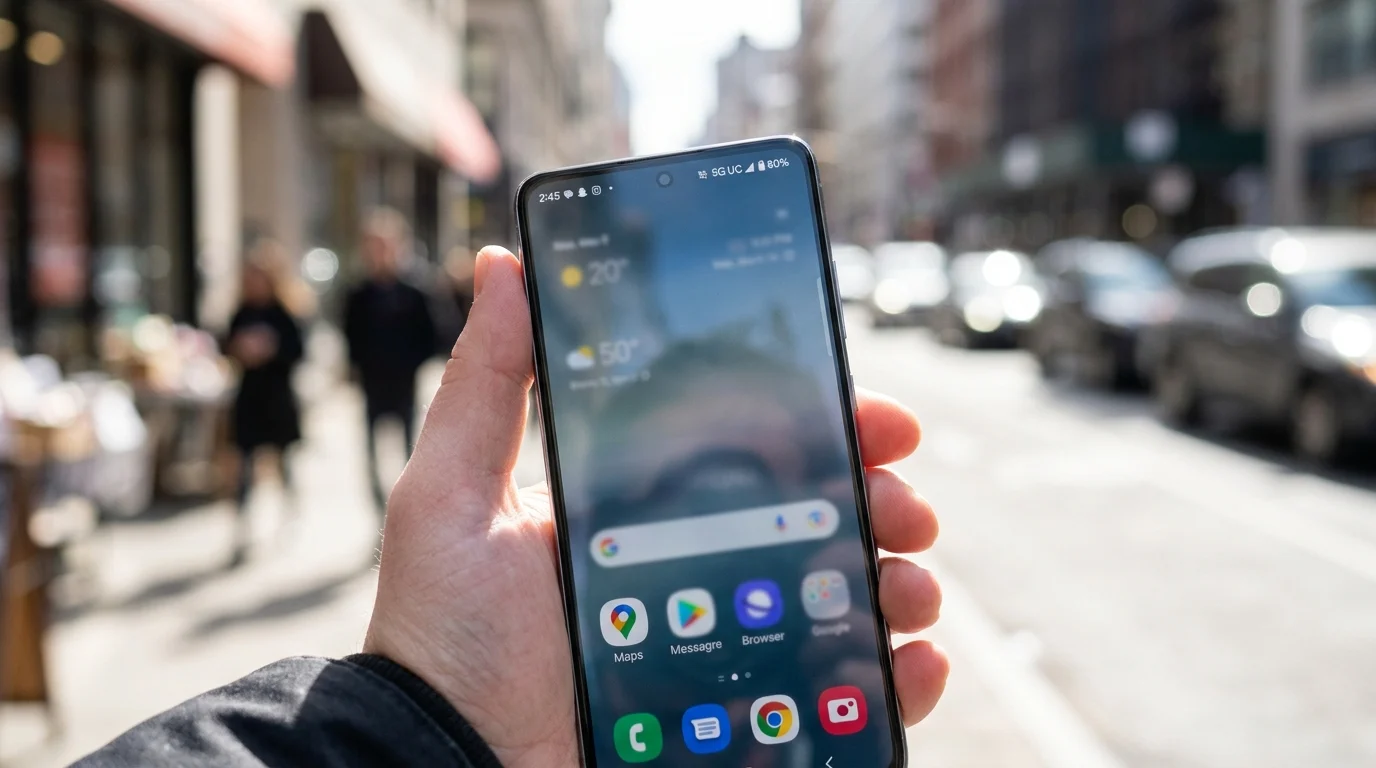
Quick Answer: 5G UC means 5G Ultra Capacity. It is T-Mobile’s name for the faster, higher-capacity layer of its 5G network. That layer uses mid-band and high-band frequencies. If you see the 5G UC icon on your phone, you are on that faster layer. You are not on T-Mobile’s broader, slower Extended Range 5G. That layer shows up as plain 5G. It is a carrier label, not a separate technology standard.
Glance at the top of your phone. You may notice the signal icon reads 5G UC instead of plain 5G. Nothing looks broken. Your connection still works. Yet the extra letters raise an obvious question: what changed? The answer is reassuringly simple. It involves a little background on how mobile networks are built. It also explains why carriers give different parts of the same network different names.
This guide explains what 5G UC means. It also explains what it tells you about your connection. It shows how it differs from regular 5G. It compares it with rival carriers’ labels such as 5G UW and 5G Plus. It also covers what to do if you expected to see it and do not. No invented speed figures are needed to understand it. The important distinction is about capacity and spectrum, not a single number.
What Does 5G UC Mean?
5G UC stands for 5G Ultra Capacity. It is the term T-Mobile uses for part of its 5G network. That part uses mid-band and high-band frequencies. These frequencies can carry far more data at once than low-band frequencies. Low-band frequencies provide the broadest coverage. That is why people describe this layer as higher capacity.
When the 5G UC icon appears on your phone, your device is on that mid-band or high-band layer in your location. When the icon shows plain 5G instead, you are on T-Mobile’s Extended Range 5G. That is the low-band layer. It forms the foundation of its nationwide coverage. Both are genuine 5G connections. They simply use different parts of the radio spectrum. They offer different trade-offs between reach and capacity.
The distinction matters because mobile data demand keeps growing. Streaming video, video calls, online gaming, and large downloads all benefit from a connection that can handle more data at once. The Ultra Capacity layer serves exactly those data-heavy uses. It helps most in busy places where many people are online at the same time.
Why Carriers Use Labels Like 5G UC
To understand 5G UC, it helps to understand spectrum. Mobile networks transmit data over radio frequencies. Those frequencies fall into broad bands. Low-band spectrum travels long distances. It also passes through walls relatively well. That makes it ideal for covering large areas. It covers rural towns and the spaces between cities. Its drawback is capacity. It cannot carry as much data at once.
Mid-band spectrum strikes a balance. It does not travel quite as far as low-band. But it carries substantially more data. That makes it well suited to cities, suburbs, and busy areas. High-band spectrum, often called millimetre wave, carries even more data. But it works over very short distances. So networks typically use it in dense locations such as stadiums, airports, and busy downtown areas.
Early 5G rollouts leaned heavily on low-band spectrum. That meant coverage arrived quickly. But speeds sometimes felt only modestly better than 4G. As carriers added mid-band and high-band capacity, they wanted a way to show customers when they were on the faster layer. That is how labels such as 5G UC were born. They are not new technologies. They are names for particular layers of an existing 5G network.
5G UC vs Regular 5G: What Is the Difference?
On T-Mobile, the comparison is straightforward. Regular 5G, shown as plain 5G on your phone, means Extended Range 5G. That is low-band spectrum. It offers broad coverage. It gives reliable everyday performance for browsing, messaging, maps, and email. 5G UC means Ultra Capacity 5G. That is mid-band or high-band spectrum. It offers greater capacity. It gives better performance for data-intensive tasks such as high-definition streaming, gaming, and large file transfers.
In practical terms, you may notice faster downloads on 5G UC. You may also notice smoother streaming. Your connection may hold up better in crowded places. You may also notice no difference at all for light tasks. Sending a text message or loading a simple web page are examples. Those tasks do not need much capacity in the first place. The icon tells you which layer you are on. Your actual experience still depends on signal strength. It also depends on how busy the local network is. And it depends on what your phone is doing.
It is also worth noting that your phone switches between these layers automatically as you move. You might see 5G UC in a city centre. You might see plain 5G on a rural road. You might see 5G UC again when you return to a covered area. You need not change any setting. The icon is a live indicator. It is not a permanent status.
5G UC vs 5G UW vs 5G Plus
Other carriers use their own labels for the same basic idea. This can be confusing if you switch networks. It can also confuse you if you compare phones with friends. The labels differ. But the underlying concept is similar. Each label names the mid-band and high-band layer of that carrier’s 5G network.
Verizon calls its faster layer 5G Ultra Wideband. Many phones show it as 5G UW. AT&T calls its faster layer 5G Plus. Many phones show it as 5G+. T-Mobile’s equivalent is 5G UC. Each carrier’s plain 5G label also differs slightly. T-Mobile calls its low-band layer Extended Range 5G. Verizon calls its nationwide low-band offering 5G Nationwide. AT&T uses plain 5G for its standard layer.
These are carrier marketing names rather than separate technology standards. So you will only ever see your own carrier’s label on your phone. A T-Mobile customer will not see 5G UW. A Verizon customer will not see 5G UC. This holds even if both stand in the same place on comparable mid-band networks. Comparing the labels directly is therefore less useful than comparing coverage and performance. Compare what each carrier offers in the places you actually use your phone.
Treat one label differently: 5G E, sometimes seen on older AT&T phones. That label refers to an enhanced form of 4G LTE. It does not refer to a 5G connection at all. Do not confuse it with 5G UC, 5G UW, or 5G Plus.
Is 5G UC a Separate Technology?
No. This is one of the most common misunderstandings about the icon. 5G UC is not a new generation of mobile technology. It is not a separate standard from 5G. It is T-Mobile’s brand name for a portion of its 5G network. That portion uses mid-band and high-band spectrum.
The underlying technology is still 5G. It uses the same standards as the rest of the network. What changes between plain 5G and 5G UC is which frequencies your phone uses at that moment. That affects how much capacity is available. Think of it less like switching to a different kind of road. Think of it more like moving from a quiet country lane to a multi-lane motorway. The vehicle is the same. But the road can carry far more traffic.
Related terms can add to the confusion. 5G Standalone, sometimes abbreviated 5G SA, refers to 5G running on a dedicated 5G core network. That differs from relying on a 4G LTE core. People call the latter Non-Standalone or 5G NSA. Standalone operation is a separate question from whether you are on the Ultra Capacity layer. A phone can be on 5G UC with either core arrangement. That depends on the network and device.
Why Do I See 5G UC Sometimes but Not Always?
There are several ordinary reasons why the icon comes and goes. The most common is location. Ultra Capacity coverage is widespread in many cities and towns. But it is not available everywhere. So your phone drops back to Extended Range 5G when you leave a covered area. Network load and signal conditions can also affect which layer your phone uses at a given moment.
Your device matters too. The 5G UC icon requires a 5G-capable phone. Its software must support displaying it. Older phones, or phones running older software, may connect to the same network layer without showing the UC letters. T-Mobile introduced the dedicated icon with iOS 15 in 2021. Android support followed through later updates. So a phone that predates that support may simply show 5G in both cases.
Your plan and carrier brand can also play a role. Customers on T-Mobile itself may see the icon. Customers on brands that run on T-Mobile’s network may also see it. But the exact display can vary by device and software version. If you are unsure, check your carrier’s coverage information. Also check your phone’s network settings. Those guides are more reliable than the icon alone.
Does 5G UC Mean My Phone Is Faster?
Generally, the Ultra Capacity layer gives your phone access to more capacity. That often translates into faster downloads. It also often means smoother performance for demanding tasks. But the icon is not a guarantee of any particular speed. Real-world performance depends on signal strength. It depends on distance from the nearest site. It depends on obstacles such as buildings. It depends on how many other people use the same site. It also depends on your phone’s capabilities.
That is why two people standing side by side, both showing 5G UC, can still have different experiences. A strong plain-5G connection can sometimes feel better than a weak 5G UC connection. The icon is useful information about which network layer you are on. But it is only one part of the picture. If your connection feels slow despite showing 5G UC, try the usual steps. Check your signal. Try moving to a different spot. Restart your connection. Check whether the issue affects other apps or just one service.
Frequently Asked Questions
What does 5G UC mean on my phone?
It means 5G Ultra Capacity. You are connected to T-Mobile’s faster, higher-capacity layer of 5G. That layer uses mid-band or high-band frequencies. It is not its broader Extended Range low-band layer.
Is 5G UC better than regular 5G?
For data-heavy tasks, yes. It offers more capacity and often faster performance. For light tasks such as messaging, you are unlikely to notice a difference. A strong regular 5G signal can still outperform a weak 5G UC signal.
What is the difference between 5G UC and 5G UW?
They are equivalent ideas from different carriers. 5G UC is T-Mobile’s name for its mid-band and high-band 5G layer. 5G UW, short for Ultra Wideband, is Verizon’s name for its equivalent layer. AT&T’s equivalent is 5G Plus.
Why does my phone sometimes show 5G and sometimes 5G UC?
Your phone switches automatically between T-Mobile’s Extended Range low-band layer and its Ultra Capacity layer. The first shows as 5G. The second shows as 5G UC. It switches as you move in and out of Ultra Capacity coverage.
Is 5G UC a separate type of 5G?
No. It is a carrier label for part of T-Mobile’s 5G network. It is not a separate technology standard. The underlying technology is still 5G.
Conclusion
5G UC means 5G Ultra Capacity. It is T-Mobile’s name for the faster, higher-capacity layer of its 5G network. That layer uses mid-band and high-band spectrum. When you see the icon, you know you are on that layer. You are not on the broader Extended Range 5G that shows up as plain 5G. Rival carriers use different names, 5G UW and 5G Plus, for the same basic idea. None of these labels is a separate technology standard.
So the next time the letters appear beside your signal bars, you can read them for what they are. They are a helpful hint that your phone has access to more network capacity right now. They are not a fault. They are not a new generation. You need not switch anything on or fix anything.


