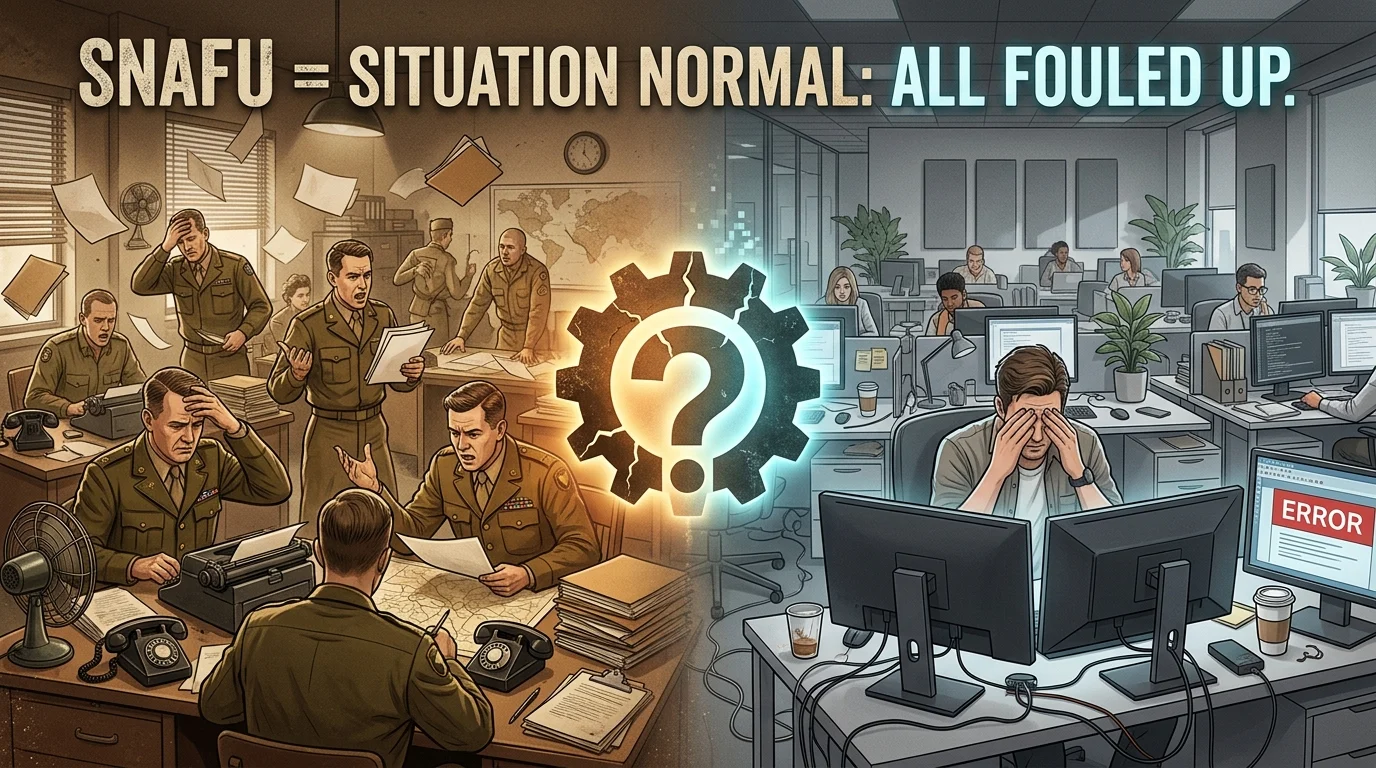
Quick Ans: SNAFU meaning is one of the most searched questions about modern slang and workplace vocabulary. In contemporary contexts, SNAFU refers to a situation that is chaotic, confused, or badly mishandled, often with the resigned implication that this disorder is completely normal. The term originated as World War II military slang and has since become a standard descriptor for bureaucratic errors, technical glitches, and everyday mix ups. Understanding this term helps you interpret news reports about institutional failures and recognize why some problems seem endlessly recurring.
Understanding modern terminology helps you follow social trends and interpret professional discussions. New questions about word meanings appear constantly, and some become cultural touchstones. SNAFU is a perfect example. It has moved from wartime barracks into mainstream media and everyday conversation. Knowing how to use it correctly helps you understand references in political coverage and workplace humor.
What Does SNAFU Mean?
SNAFU is an acronym that stands for “Situation Normal: All Fucked Up,” often softened in polite company to “all fouled up” . It describes a scenario where chaos, confusion, or error is not an exception but the expected state of affairs. The term carries a sardonic tone it acknowledges that things are bad, but shrugs that this is simply how things always are .
Sometimes people use it casually to describe a minor inconvenience. Other times it appears in serious reporting about institutional breakdowns. All versions relate to the same core concept: a mess that feels frustratingly familiar. The distinction usually depends on the scale of the failure and the tone of the speaker.
The concept carries significant cultural weight. It connects to military history, bureaucratic critique, and modern attitudes toward institutional competence. Understanding the meaning helps you follow political commentary and interpret why some failures become cultural shorthand for systemic dysfunction.
Where Did the Term Come From?
The SNAFU origin traces back to World War II and American military slang. The acronym is believed to have emerged in the early 1940s, with the first known publication appearing in The Kansas City Star on July 27, 1941 . The Oxford English Dictionary credits its first recorded use to U.S. military slang, though some sources have also attributed it to British forces .
The term was born from soldiers’ cynical observations about army inefficiency. As one scholar noted, SNAFU represented “a caricature of Army direction,” expressing “the soldier’s resigned acceptance of his own less responsible position” and his “cynicism at the inefficiency of Army authority” . The expression spread rapidly through the ranks and into civilian use during the war years.
The acronym gained wider prominence through wartime journalism. Time magazine used the term in its June 16, 1942 issue, reporting that “U.S. citizens knew that gasoline rationing and rubber requisitioning were snafu” . A fictional character called Private Snafu appeared in instructional cartoons produced by Warner Bros. during the 1940s, with stories written by Dr. Seuss and voice work by Mel Blanc, cementing the term in popular culture .
The concept spread beyond military contexts after the war. Corporations, government agencies, and everyday speakers adopted SNAFU to describe bureaucratic chaos and organizational failure. The term became a symbol of modern skepticism toward institutional competence.
SNAFU in Legal Contexts and Media
The term has appeared in countless news reports and official documents across every medium. Understanding these appearances helps you see how the concept evolved from slang to standard vocabulary.
News media frequently use SNAFU when reporting institutional failures and procedural errors. A 2005 New York Times article titled “Hospital Staff Cutback Blamed for Test Result Snafu” illustrates how the term has become a concise way to signal a significant but familiar kind of failure . Headlines routinely use the word to describe election errors, transportation breakdowns, and technology outages.
Legal and bureaucratic documents occasionally employ the term in informal correspondence. While not a formal legal term, SNAFU appears in client communications and internal memos to describe procedural mix ups that require attention.
Educational institutions reference SNAFU in courses on organizational behavior, communication, and modern history. The term serves as a case study in how military slang enters mainstream language and how acronyms can capture complex social attitudes.
The Science Behind SNAFU
Modern psychology and linguistics offer explanations for why people use and maintain SNAFU. Understanding these theories helps separate logical concepts from emotional rationalizations.
Cynical acceptance. Researchers believe SNAFU is used to signal resigned familiarity with dysfunction. The emphasis on “normal” discourages surprise or outrage. This can protect individuals from constant frustration but also lead to complacency about fixable problems.
Social bonding. Some researchers emphasize the role of shared language in group cohesion. Using SNAFU with colleagues signals membership in a community that understands the same frustrations. This aligns with workplace culture research on humor as a coping mechanism.
Tradition and military heritage. Some advocates believe SNAFU usage persists because of its clear wartime origins. The term carries authenticity from its military roots. This reflects societal respect for soldiers’ language and the durability of World War II vocabulary.
Gradual euphemization. Many SNAFU usages include softened versions like “fouled up” or “screwed up.” Speakers often adapt the term to their audience. This recognizes that language evolves to balance precision with social appropriateness.
Regional variation. Different regions and industries have varying preferences for SNAFU. Military communities use it more readily than corporate environments. Culture can shape individual usage by defining what level of vulgarity is acceptable.
SNAFU vs FUBAR vs Clusterfuck
These terms are often confused or used interchangeably. Understanding the differences helps you use them correctly.
SNAFU refers to a situation that is chaotic or confused, with the implication that this is normal or expected. The term emphasizes the routine nature of the dysfunction.
FUBAR stands for “Fouled Up Beyond All Recognition.” It describes a situation that is not just messy but irreparably damaged. FUBAR implies a level of destruction that goes beyond SNAFU’s familiar chaos.
Clusterfuck describes a chaotic situation involving multiple compounding errors and often multiple people. It emphasizes the cascading nature of the failure rather than its normality.
In casual conversation, people sometimes use these terms interchangeably. A colleague might say “total SNAFU” when they actually mean a clusterfuck. This is common but technically imprecise. The distinction usually depends on the scale and permanence of the failure.
SNAFU in Modern Culture
The concept has moved beyond military history. Today it appears in media, corporate language, and everyday speech.
SNAFU in the news. Journalists frequently use SNAFU to describe government errors and corporate failures. The term has become shorthand for institutional incompetence in media coverage.
SNAFU in corporate culture. Organizations use the term in internal discussions about procedural errors and project failures. The goal is often to acknowledge problems without assigning individual blame.
SNAFU in education. Universities and military academies teach SNAFU as part of communication history and organizational behavior courses. The term appears in textbooks and case studies on institutional failure.
SNAFU in online discussions. People discuss SNAFU situations on social media and forums, often sharing stories of bureaucratic absurdity. The term appears in conversations about workplace frustration and political dysfunction.
In entertainment. Books like “SNAFU: The Definitive Guide to History’s Greatest Screwups” and the Private Snafu cartoon series have brought the term to new audiences .
When to Use the Term SNAFU
The term works in several different situations. Its sardonic precision makes it valuable in discussions of institutional failure.
The most common usage is in informal professional settings. A colleague might describe a scheduling error or system outage as a SNAFU. The tone is resigned and slightly humorous.
Another common usage is in news commentary. A writer might reference a “bureaucratic SNAFU” to describe a government error. The tone is critical but not outraged.
The term also appears in personal conversations. Someone might say “the whole trip was a SNAFU” when describing a vacation plagued by problems. The tone is conversational and self deprecating.
The word can also be used as an adjective. Someone might describe “a SNAFU situation” to emphasize the chaotic nature of circumstances. The tone is descriptive and slightly wry.
How to Use SNAFU in a Sentence
Using the term correctly helps you communicate clearly. Here are some examples.
As a noun: “The launch was a complete SNAFU from start to finish.” This is the most common usage. It describes a specific chaotic event.
In a bureaucratic context: “Officials blamed the delay on a scheduling SNAFU.” This usage draws on the term’s association with institutional error.
In news reporting: “A ballot SNAFU led to a recount in three districts.” This is a journalistic usage.
In casual conversation: “Another Monday morning SNAFU at the office.” This is a conversational and relatable usage.
As an adjective: “The SNAFU operation left everyone exhausted.” This usage is less common but still understood.
Plural form: “The project suffered through a series of SNAFUs.” The plural is common and widely accepted.
FAQs
What does SNAFU mean?
SNAFU stands for “Situation Normal: All Fucked Up” (or “fouled up” in polite usage). It describes a chaotic or confused situation, with the sardonic implication that this disorder is completely normal .
Is SNAFU the same as FUBAR?
SNAFU and FUBAR are related but not identical. SNAFU emphasizes that the chaos is normal and expected, while FUBAR (“Fouled Up Beyond All Recognition”) emphasizes that the damage is irreparable. The terms are sometimes used interchangeably in casual speech.
When did SNAFU originate?
SNAFU originated during World War II as American military slang. The first known publication was in The Kansas City Star in July 1941 . It spread through wartime journalism and cartoons featuring Private Snafu.
Is SNAFU appropriate in professional settings?
SNAFU is generally acceptable in informal professional settings, especially when the softened version “fouled up” is implied or stated. In formal writing or conservative workplaces, alternatives like “mix up” or “procedural error” may be more appropriate.
Can SNAFU be used as a verb?
Yes. SNAFU can function as a transitive verb meaning to throw something into disorder. For example: “The new software snafued the entire billing process” .
Conclusion
The SNAFU meaning is clear and culturally significant. It refers to a chaotic or confused situation, often with the resigned acknowledgement that such disorder is routine. You can use it in workplace discussions, news commentary, and casual conversation. It is a term that connects modern organizational critique to its World War II origins. When you see SNAFU in a headline or hear it in a meeting, you now know exactly what it means. Use it with precision, and your understanding of this enduring piece of military slang will deepen.
Discover More:
- POS Meaning: What This Versatile Acronym Stands For 2026
- What Does “DTF” Mean? The Complete Guide to This Blunt 2026










1 thought on “SNAFU Meaning: What It Really Means & Examples 2026”