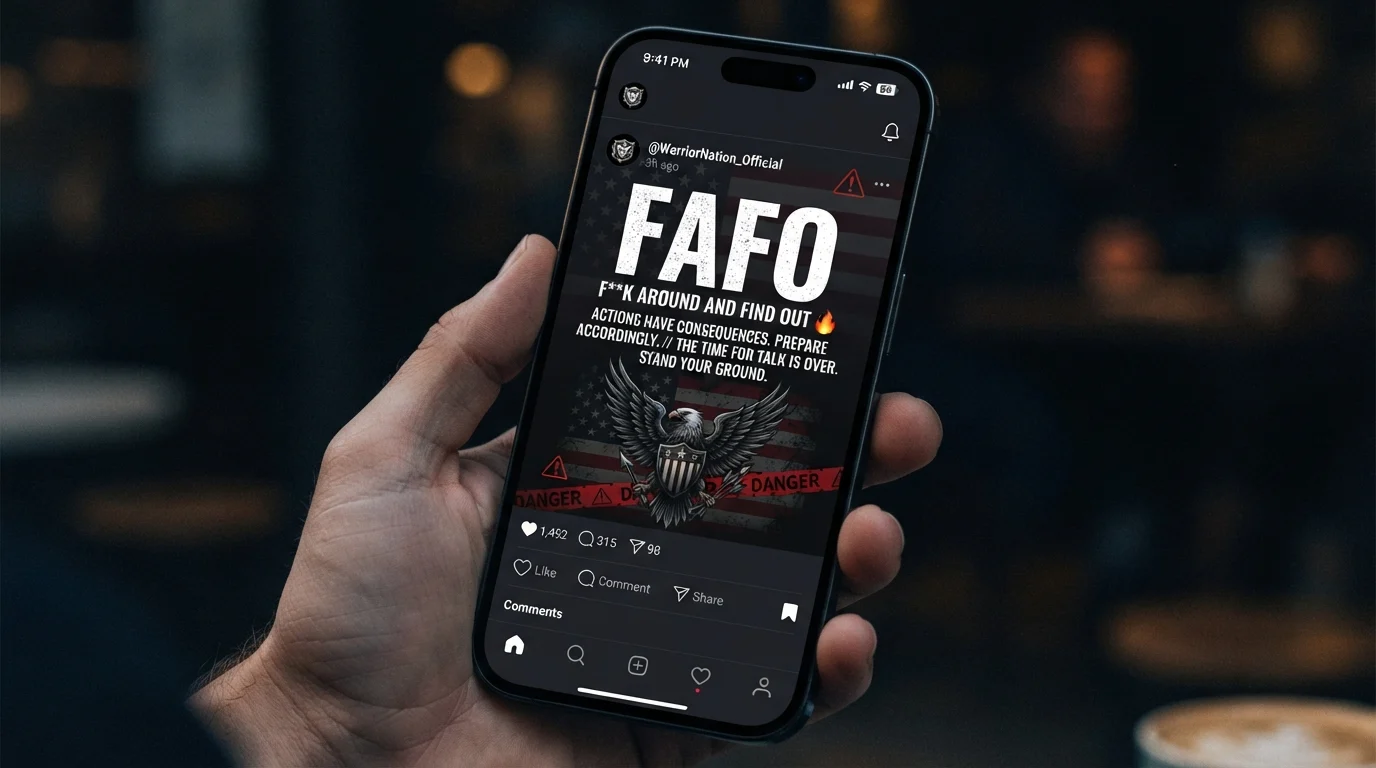
You’re scrolling through X or TikTok when you see it: a post that just says “FAFO” with a photo attached. Or maybe a friend texted it to you after you ignored their warning about something. Either way, the all caps format makes it clear this isn’t a friendly reminder.
FAFO stands for “F*** Around and Find Out” (or more politely, “Fool Around and Find Out”). It’s a warning that if someone acts recklessly or provokes trouble, they will face predictable and deserved consequences. While the term has roots in African American English and military slang, it exploded into mainstream political and social media discourse in early 2026, becoming one of the most recognizable warning phrases in online culture.
This article breaks down what FAFO means, where it came from, and how you should interpret it when it lands in your feed.
Quick Answer
| Aspect | Details |
| Full Form | F*** Around and Find Out (or Fool Around and Find Out) |
| Tone | Warning, confrontational, sometimes schadenfreude |
| Platforms | X/Twitter, TikTok, Reddit, news media, political discourse |
| Formal or Informal | Strictly informal, vulgar in its primary form |
| Pronunciation | Either “FAFF-oh” or spelled out letter by letter |
FAFO is an acronym used as a warning or challenge to indicate that unwanted behavior will result in dire consequences. It’s essentially a harsher, more aggressive version of “I warned you” or “You had it coming.”
The Main Meaning Behind FAFO
The full form is exactly as blunt as it sounds: “F*** around and find out.” Every word contributes to the warning tone. The “around” part implies foolish, reckless, or provocative behavior, while “find out” promises that consequences are coming.
People use FAFO when they want to warn someone that their actions have limits, or when they’re observing someone suffering the results of their own bad choices. Unlike gentler warnings like “be careful” or “you might regret that,” FAFO leaves no room for interpretation. The speaker is saying: you were warned, and now you’re paying for it.
The tone can be confrontational when used as a direct warning, but it’s also frequently used to express schadenfreude satisfaction at someone else’s deserved misfortune. Context and who’s speaking determine whether it lands as a threat or an observation.
Example:
Person A: “I’m going to keep trolling the comments until someone fights me.”
Person B: “FAFO, that’s all I’m saying.”
Here, Person B is issuing a direct warning. The tone is dismissive and slightly hostile, signaling that Person A’s actions will have predictable consequences.
How FAFO Became Mainstream
FAFO didn’t start as a political slogan. Its usage originated in African American English and has since become widespread across different communities. The phrase also has deep roots in military culture, where it’s been used for years as a blunt warning about the consequences of reckless behavior.
What sent FAFO into the mainstream was a specific political moment. In January 2026, the White House posted a black-and-white photo of President Donald Trump with the acronym “FAFO” written across it, following the capture of Venezuelan President Nicolás Maduro. The caption read: “No games, FAFO.”
The post went viral immediately. Elon Musk reacted, news outlets around the world covered it, and the term suddenly appeared everywhere from political commentary to memes. Defense Secretary Pete Hegseth had previously used the slang in an October 2025 address to military commanders, saying: “To our enemies, FAFO. If necessary, our troops can translate that for you.”
By early 2026, FAFO was appearing everywhere from X to TikTok to international news headlines, becoming shorthand for a foreign policy approach that prioritized strength and consequences over diplomatic niceties.
How FAFO Is Used in Different Contexts
As a political warning: The White House’s use of FAFO signaled a foreign policy stance that consequences would follow swiftly and harshly for those who challenge U.S. interests. The term’s ambiguity no one knows exactly where “eff around” stops and “find out” begins is part of its power, offering plausible deniability while still conveying threat.
As military slang: FAFO has been used by service members for years, appearing on Reddit’s r/Military and even on merchandise. It conveys the idea that provoking the military will result in overwhelming force.
In FAFO parenting: A parenting trend borrowed the phrase to describe a hands-off approach where parents let natural consequences teach children instead of intervening. If a child refuses to wear a jacket, they get cold. If they don’t do homework, they get a lower grade. Critics note that this approach can feel harsh or unsupportive if not balanced with empathy and guidance.
As everyday internet slang: People use FAFO in comment sections, group chats, and social media posts to warn someone they’re about to face consequences, or to express satisfaction when someone finally does.
How to Interpret FAFO
If someone sends you a FAFO, you have a few options depending on the situation and how you want to handle the tension.
Take it seriously when:
- It comes from someone in authority or with actual power over the situation
- It’s paired with specific actions (a policy change, a ban, a consequence)
- The context involves real stakes legal, professional, or physical
Brush it off when:
- It’s clearly playful banter among friends
- The “consequence” is vague or exaggerated
- The person using it has no actual ability to enforce anything
Polite Replies (When You Want to Defuse):
“Fair enough”
“Noted”
“I’ll keep that in mind”
Confused Replies (When You’re Genuinely Lost):
“What does that mean”
“Are you threatening me or just memeing”
Playful Replies (When It’s All in Fun):
“Found out already, thanks”
“Living by that motto”
When You Should Avoid Using FAFO
FAFO has a very specific lane, and straying outside it can cause real problems.
Use it carefully in: Casual group chats with friends who understand the humor, social media comments where the tone is already chaotic, and playful banter where everyone’s in on the joke.
Avoid it in: Professional emails, work Slack channels, academic writing, messages to family members, and any conversation with someone who might genuinely take it as a threat. The vulgar component makes it a real warning, not just a mild dismissal. Even the “polite” version (“Fool Around and Find Out”) carries a confrontational edge.
Common Misunderstandings About FAFO
| Common Mistake | Correct Understanding |
| Thinking it’s just internet slang | It originated in African American English and military culture |
| Believing it’s a new term | The acronym has been used for years before its 2026 political moment |
| Assuming it’s always a threat | It’s also used to express schadenfreude or satisfaction at deserved consequences |
| Thinking it has a wholesome meaning | Unlike some slang, FAFO has no positive alternative interpretation |
Similar Slang Terms You Might See
| Term | Meaning | Key Difference |
| FYAFO | F*** You Around, Find Out | More aggressive, directed at a specific person |
| AHAB | All Hat, No Balls | Insult about someone being all talk |
| Play foolish games, win foolish prizes | You deserve what you get | Full phrase, same sentiment, no vulgarity |
| Mess around and find out | Polite version of FAFO | Less aggressive, suitable for mixed company |
These terms often appear together in online discourse, but each serves a slightly different conversational purpose.
FAQs
What does FAFO stand for in text?
It stands for “F*** Around and Find Out” (or “Fool Around and Find Out”), an aggressive way to warn someone that their actions will have negative consequences.
Is FAFO rude or offensive?
The primary form contains vulgar language and is confrontational, though the “fool around” version is milder. Context determines whether it’s a genuine threat or playful warning.
Why did FAFO become so popular in 2026?
The White House used the acronym in a viral post following the capture of Venezuelan President Maduro, bringing it from internet slang into mainstream political discourse.
Can FAFO be used positively?
Not really. The phrase is inherently about warnings and consequences. The “positive” version would be something like “learn from experience,” which defeats the purpose of the warning.
How do you respond to FAFO?
A short, lighthearted reply works for banter, while disengaging or taking the warning seriously is best when the stakes are real.
Final Thoughts
FAFO means “F*** Around and Find Out.” It’s not a compliment, and it’s not new. The acronym originated in African American English and military culture, then exploded into mainstream discourse in 2026 through a viral White House post.
Use it only in casual, playful contexts where everyone understands the warning. If someone sends it your way and you’re not sure of their intent, a lighthearted response or simple disengagement usually works better than firing back. Now you know what FAFO means, and more importantly, when to take it seriously.